Bloodbinder's Ascent
✨ Start ReadingAbout This Novel
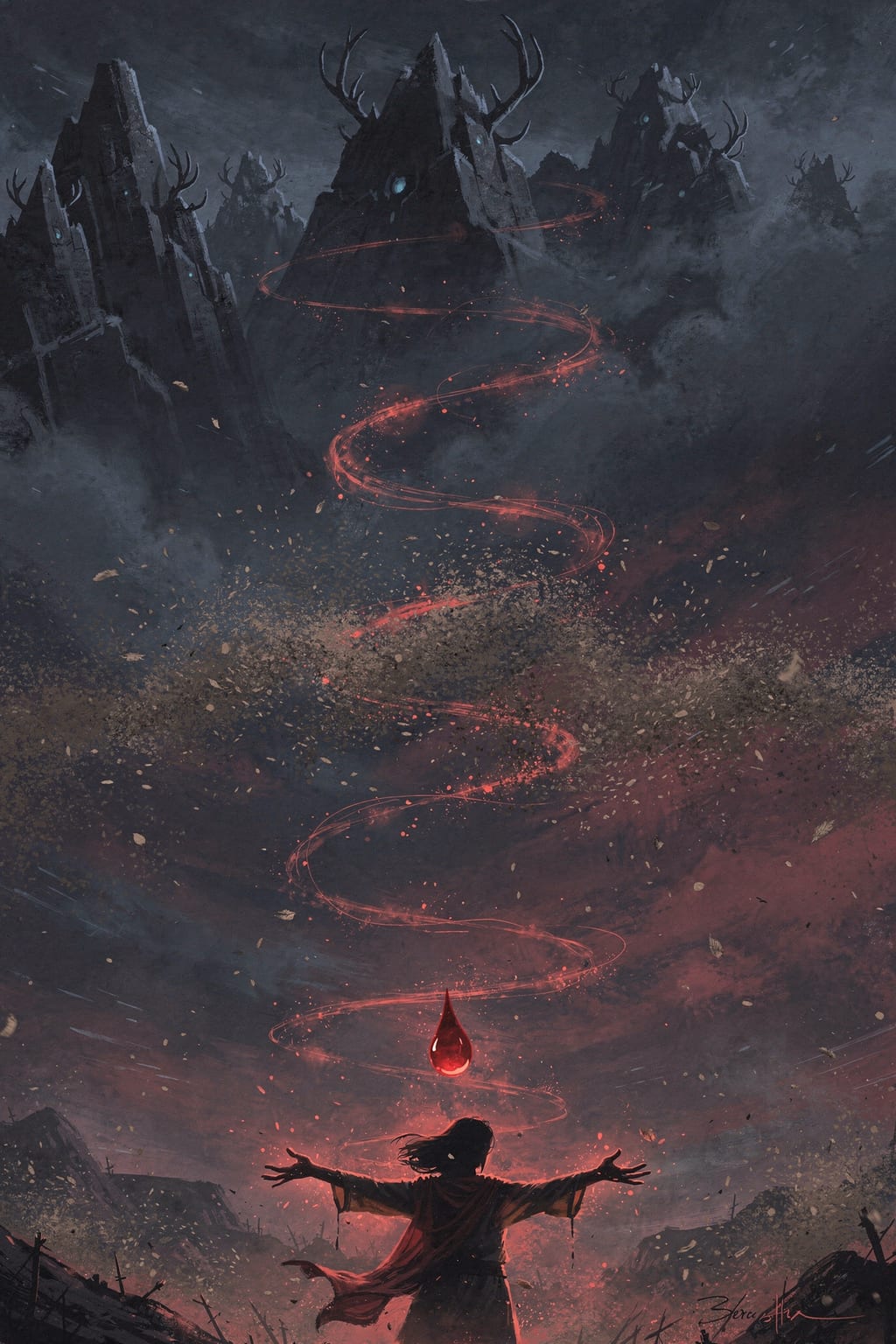
In the ash-choked slums of Sootfall, a starving orphan named Sera presses her bleeding palms to a dying dog's wound — and shatters a two-hundred-year-old seal, awakening the Red Covenant, the one cultivation art the Nine Luminaries Court burned from history. Now the revered White Antler Sect is hunting her, not to destroy the art, but to farm it — and Sera discovers the technique's terrible price: every drop of stolen blood makes her stronger and numbs her ability to feel the pain of others, the very gift that made her a healer. To rise from gutter-orphan to ascendant, she must answer the question that destroyed the art's founder: is power what you take, or what you're willing to be given?
Opening Line
"The ash came down at four, same as always, and Sera kept working through it because ash didn't pay and copper did."
Chapter 1
"What the Ash Keeps"From the Tenth Decree of the Nine Luminaries Court, posted in every market square in the Reaches:
Let it be known that the art called the Red Covenant is stricken from the world, its practitioners dead, its bloodline extinguished, its name preserved here only so the faithful may know what to hate. Let none mourn it. Let none seek it. The Reckoning was thorough.
— By the hand of the Luminaries, in the two-hundredth year of the peace.
The ash came down at four, same as always, and Sera kept working through it because ash didn't pay and copper did.
The engine was a corpse. Some sect hauler's rust-chewed heart, dumped in the Rustyards when it stopped being worth the repair, half-buried in a dune of its own leaking grease. Sera had been on it since midday, wrists deep in its chest cavity, and she had the copper coil's location mapped in her head like a route home: past the cracked housing, left of the seized piston, wrapped around a fitting that fought her every quarter-turn.
"Come on," she muttered. "Come on, you miserly bastard."
The fitting gave. The coil came free in a bright orange snake, and she laughed once, short, before the ash settled on it and dulled it to the color of everything else.
She wiped her hands on her trousers, which did nothing, since her trousers were made of the same grime. Her knuckles were split in three places — the soot got into the cracks and stayed there, so the creases of her hands were drawn in permanent black, like someone had inked a map of the Rustyards onto her skin. She'd stopped trying to wash it out years ago. The water in the undercity cost more than the dignity was worth.
The coil went into her sack with the rest of the day's take: two fistfuls of wire, a brass valve, one unbroken glass lens she might get a whole coin for if Fen's mood was good, which it never was.
She was coiling the last of the wire when she heard the whine.
Not an animal. A hinge. She knew the difference — she'd spent enough nights in these dunes to have a whole taxonomy of Rustyard sounds, and this was the wheel of Fen's cart, which meant Fen's runner, which meant her afternoon was about to get worse.
"Sera." The runner was a boy named Cobb, fourteen, all elbows and borrowed authority, riding the cart bench like he was driving a war carriage. "Fen says you're on his dune."
"Fen's dune." Sera didn't look up. "Funny. I don't see his name on it."
"Fen's name is on everything east of the slag wall."
"Then Fen should label things better. I can't read greed."
Cobb's mouth did the thing it did when he wanted to laugh and remembered he wasn't supposed to. "He says the engine's his. He says the copper in your sack is his."
"The engine was thrown away by a sect hauler who paid Fen nothing for it, dumped on a dune nobody owns, and stripped by hands that are mine." She stood, sack over her shoulder, and let him see the salvage knife at her belt — not drawn, just present, like a fact in an argument. "Tell Fen I'll pay his cut on the brass. The copper's mine. I bled on it. That makes it family."
"Fen's going to say—"
"Fen's going to say a lot of things. He's a man of many words and no baths." She hopped down off the engine housing. "Give him my regards. The warm ones. He'll know which."
Cobb stared at her for a moment, weighing his orders against her knife and her reputation, and came to the correct conclusion. He clicked his tongue at the mule and the cart creaked away into the ash, the hinge whining its thin complaint until the dunes swallowed it.
Sera waited until he was gone before she let her shoulders drop. Fen would send someone bigger than Cobb eventually. That was a tomorrow problem. Today she had copper, a lens, and a stomach that had stopped asking and started negotiating.
She spat the ash taste out of her mouth — it got on the tongue like burnt paper, like the city was trying to season her — and started walking.
The Rustyards gave way to Cindermarket the way a bad dream gives way to a worse one: gradually, then all at once. The scrap dunes shrank into shanties, the shanties crowded into stalls, and suddenly she was in the thick of it, dusk coming down purple through the ash, the whole market lit by cookfires and biolume jars strung on wire.
Cindermarket smelled like everything at once. Noodle broth and hot oil. Rust from the canals, where the sect's alchemy runoff ran red down the middle of the city like a wound that never scabbed. Charcoal, dung, frying garlic, the sharp chemical reek that blew down off the mountain when the wind was feeling vindictive. Eighty thousand people crammed into a river gorge, and every one of them cooking, burning, or sweating.
Sera moved through it the way she moved through everything: fast, loose, eyes working. Exits counted without thinking. A dropped coin spotted before the dropper noticed. She'd been raised by these streets the way wolves are raised by the forest — fed by them, bitten by them, fluent in them.
At the corner where the fish-seller's awning sagged, she stopped.
The heel of bread had been in her coat all day, wrapped in a scrap of oilcloth, and it was the whole of her dinner plan. Hard as a brick, three days old, scavenged from behind the bakery on Tallow Row where they threw out the ends. She'd been looking forward to it the way you look forward to things when there's nothing else coming.
The cat was sitting under the awning, watching her.
One eye. The other was a closed seam of scar, old, long healed. It was a gray thing, thin as a rumor, and it didn't beg — that was what got her. It just sat there, spine straight, one eye on the bread in her hand with the focused dignity of a magistrate reviewing evidence.
"No," Sera said.
The cat said nothing.
"I mean it. This is dinner. All of it. There's a plan."
The cat's ear twitched.
Sera looked at the bread. Looked at the cat. Looked up at the sky, where the ash kept falling through the last of the light like the world's least festive snow, and said, to no one, "This is why I don't have anything."
She broke the heel in half and set the bigger half on the stones.
The cat ate with the same dignity, unhurried, like it had expected nothing less. Sera crouched and ate her half leaning against the awning post, and for a minute the two of them chewed in companionable silence while the market roared around them.
"You've got a better coat than me," she told the cat. "Don't let it go to your head."
The cat finished, regarded her with its one eye for a long moment — a look that contained, Sera felt, the entire sum of what cats thought of people — and walked off into the dark without a backward glance.
"You're welcome," she called after it. "Ungrateful little—" But she was smiling.
She was three stalls from Hesh's Kettle, already tasting the broth in her head, when she saw the boy.
Pip. Six years old, maybe seven — slum kids' ages were guesses. He was sitting on the curb outside the noodle stalls with his knees drawn up, trying very hard not to look at anyone's food and failing in the obvious way children fail at everything. His mother ran the reed-basket cart on Tithe Street; Sera knew her by sight, knew the cart was a day late on the scrap-boss's fee because everyone knew everything in Cindermarket eventually. Pip was out here not-begging while his mother worked the late crowd, and he was doing it badly, and Sera's dinner coin was suddenly the heaviest thing in her coat.
She almost walked past. She'd already given away half a loaf today. There was a limit. A person had to have a limit or the city would strip her to the bone and sell the bone.
Pip's stomach growled. Audibly. He looked mortified.
Limit, she told herself firmly, and stopped walking.
"Oi." She flipped the coin at him. He caught it the way slum kids catch everything — fast, both hands, already half-hidden. "Noodle money. Get the small bowl, tell Hesh I sent you, and if you buy sweets with it I'll know, because I know everything, and I'll haunt you like a tax."
Pip stared at the coin. Then at her. His eyes went enormous and wet, and his mouth opened to say something —
"Don't," Sera said. "Don't say anything. Don't do the face. The face is why nobody feeds you, it's tragic, you look like a drowning puppy." She pointed down the row. "Go. Small bowl. And eat the broth, that's where the food is."
He went, clutching the coin, moving at that run-walk kids do when they're afraid a miracle has a time limit.
Sera watched him go and did the arithmetic in her head. No dinner coin. Half a loaf gone to a cat. Copper money earmarked — three months of earmarking — for boots, because hers had a hole in the left sole the size of a plum and winter had opinions about that. Boots first. Boots were survival. Dinner was a luxury, and luxuries were for people above the smog line.
Her stomach, consulted, voted against the entire arrangement.
"Shut up," she told it, and went to see Granny Hesh.
Hesh's Kettle sat wedged under a fallen aqueduct arch at the market's north edge, where the old stone made a ceiling the rain and ash couldn't get through. Four stools. One dented pot the size of a cauldron, older than anyone who ate from it. A counter made from a door. It was, by any measure the sects would recognize, nothing — and it was the safest place in Sootfall, and everyone below the smog line knew it, though nobody could have told you why.
Granny Hesh stood behind the pot like a monument. Seventy-something, built like the kettle she ran, forearms thick as mooring rope from fifty years of noodle-pulling. One eye milky white, the other sharp enough to cut wire. She was pulling noodles when Sera ducked under the arch — arms working, the dough rope doubling and doubling, slap, twist, slap, the strands multiplying under her hands like a trick of arithmetic.
"You're late," Hesh said, without looking up.
"I'm never late. There's no schedule."
"You're late for the schedule in my head." Slap, twist. The noodles went into the pot. "Sit. You look like a crow's opinion."
Sera sat. The stool was warm from the last customer. Pip was at the end of the counter with his small bowl, eating with the total focus of someone refueling for the rest of his life, and he gave her a solemn nod, mouth full, which she returned with a two-fingered salute.
Hesh set a bowl in front of her. Full bowl. Extra noodles, an egg cracked into the broth, a scatter of scallion — the good bowl, the one that cost a coin and a half.
"I can't pay for that," Sera said.
"Did I ask?"
"My coin's gone."
"I know where your coin's gone." Hesh's good eye flicked toward Pip, then back to Sera, and there was nothing soft in her face at all, which was how you knew she was pleased. "Boy came in here waving it like a flag. Said a scary girl with dirty hands gave it to him."
"I'm not scary."
"You're terrifying. Eat."
Sera ate. The broth was rich and salty and hot enough to hurt, and the egg had gone silky in it, and for a while there was nothing in the world but the bowl and the steam and the ache of a full stomach coming back online. Hesh worked the counter, serving the evening crowd — dockers, rag-pickers, a pair of pit-fighters with fresh bruises and old money — and the stall filled with the low warm noise of people who'd made it through another day and were taking their reward in noodles.
When the rush thinned, Hesh came and stood across the counter from her, arms crossed, and looked at her for a long moment with the one good eye.
"What," Sera said warily.
"You gave the boy your dinner."
"He was doing the face."
"You gave half a loaf to that one-eyed stray behind the fish stall, too. Don't look surprised. Nothing happens in this market I don't know about before it finishes happening." Hesh uncrossed her arms, reached over, and turned Sera's hand palm-up on the counter — the knuckles split, the soot in the creases, a fresh cut along the thumb from the engine. She looked at it the way a moneylender looks at a bad ledger. "Seventeen years old and you spend like a drunken saint."
"It was half a loaf, Hesh."
"It's never the loaf." The old woman let go of her hand. "It's the habit. You feed everything that looks at you. Cats. Boys. Strays of every description." A beat. "Present company."
"You feed me," Sera pointed out.
"That's different. I'm investing."
"In what?"
Hesh didn't answer that. She took Sera's empty bowl, set it aside, and leaned on the counter, and for a moment the banter went out of her face and something older looked out — something that had been watching Sera for a very long time, from very close up.
"Kindness is the most expensive thing in Sootfall, girl," she said. "Spend it anyway — just never let them see the price."
Sera chewed on that. The first half she understood — she'd paid the price her whole life, in coins and bread and the hole in her boot. The second half sat in her chest like a stone she couldn't quite swallow.
"Why not?" she asked. "Why can't they see it?"
"Because if they see the price, they'll think you're paying it for them. And then they owe you, or they think they do, and owing curdles. It turns to shame, and shame turns to hate, and one day the boy you fed burns your stall down because he can't stand the sight of you." Hesh shrugged, a movement like a mountain settling. "Or they see the price and decide you're a mark. Either way. Spend it, hide it, keep your books closed."
"That's the most depressing advice I've ever heard."
"You live here," Hesh said. "It's the only kind I stock."
Sera huffed something that was almost a laugh. Pip had finished his bowl and was scrubbing it himself, standing on tiptoe at the wash barrel, and Hesh watched him with her milky eye and her good one both, and said, quieter, almost to herself:
"Some of us can afford to be hard. The world's already spent everything on us." She took the boy's bowl from his sudsy hands and ruffled his hair with a forearm like a dock line. "You can't, girl. That's not a compliment. It's just a fact about your construction. Like the pot. It holds what it holds."
"I'm not a pot."
"You're exactly a pot. Now get out of my stall, I've got closers to feed and you've got a hole in your boot the size of a plum."
Sera froze with one foot off the stool. "How do you know about the boot?"
Hesh's face rearranged itself into an expression of total innocence, which on her was more alarming than any scowl. "Lucky guess."
The ash had thickened by the time Sera left the Kettle, coming down through the dark in slow gray flakes that caught the cookfire light like sparks going the wrong way. She took the long way home, up the switchback lane that climbed the gorge wall toward the Rustyards, because her legs wanted the climb and her head wanted the quiet.
Pip had run off into the dark full of noodles. The cat was fed. Fen's cut was paid, mostly, and tomorrow's problems were firmly tomorrow's. Her stomach was warm. Her boots had a hole. It was, by Cindermarket standards, a good day.
She stopped at the bend where the lane came out above the rooftops, the place she always stopped, because the whole city opened up there like a hand.
Below her, Cindermarket burned with ten thousand small lights — cookfires, lamps, the red glow of the canals where the runoff ran, all of it smeared and softened by the falling ash into something almost beautiful, the way a bruise is almost a sunset if you squint. The undercity. Her whole world, laid out in smoke and noise and stubborn, grubby warmth. Eighty thousand people the sects had written off as rootless, labor, tithe — and every one of them down there sharing bread and insults and making it to tomorrow.
Above it, the smog line.
It sat on the gorge like a lid, a brown-gray ceiling the undercity breathed up and the wind never quite cleared. And above the smog line — where the air was clean, where the ash never fell, where people had never once tasted rust in their water — White Antler Mountain rose out of the clouds like something from a different story entirely. The sect's terraces caught the last of the light off the western sky and held it, white stone gleaming, tier after tier of pine courts and antler-gated shrines stacked up into the darkening blue, serene and spotless and utterly indifferent to the city smoking at its feet.
Sera had been born under that mountain. Seventeen years, and no one up there had ever looked down at her — not at her, not at the market, not at the boy with the drowning-puppy face or the old woman with the ladle. They took the tithes down the Gullet and sent their collectors down the Gullet and everything else about the undercity they ignored the way you ignore the dirt under a floor.
She stood there a while, ash settling in her hacked-short hair, one hand absently rubbing the split knuckles of the other.
Above the smog line, the white terraces of the sect gleamed like clean teeth, and Sera — who had never once been looked at by anyone up there — looked back.
Tropes
Chosen OneForbidden PowerMoral DilemmaUnderdog ProtagonistSecret Cultivation ArtAll 18 Chapters
Frequently Asked
What genre is Bloodbinder's Ascent?
Bloodbinder's Ascent is a Xianxia / Dark Xianxia novel with gritty, dark, intense tones exploring themes of power and corruption, redemption, sacrifice.
How long is Bloodbinder's Ascent?
Bloodbinder's Ascent is 68,797 words across 18 chapters, roughly 98% the length of a standard published novel.
What books is Bloodbinder's Ascent similar to?
Readers who enjoyed The Poppy War, Cradle, A Thousand Li tend to enjoy this novel, particularly its gritty tone and chosen one elements.
How was this novel written?
Bloodbinder's Ascent is a collaboration between humans and AI on Whimsy Ink. A human and AI collaborate on a concept and write the book together. Every novel is unique.
Who are the main characters in Bloodbinder's Ascent?
The main characters include Sera (The Reluctant Chosen One), Cobb (The Lackey), Fen (The Exploiter).
Want a novel like this?
Describe it. We'll write it.
✨ Dream Your Own