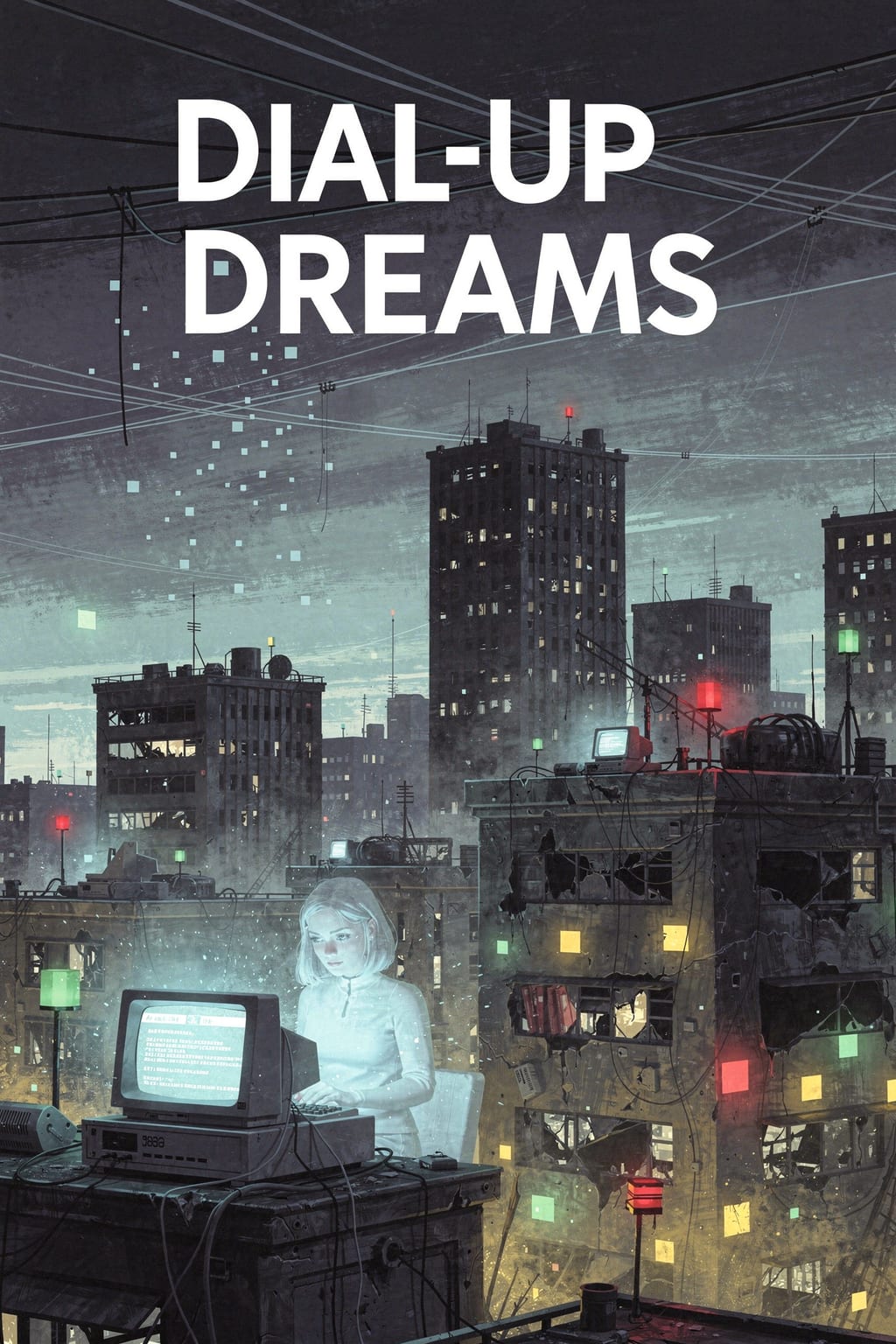
About This Novel
Dial-Up Dreams is a cyberpunk · retro-futura novel, following Here are the detailed character profiles for Dial-Up Dreams:, .
Opening Line
"The static was a voice, and the voice was saying nothing, and Peggy had been listening to it say nothing for three hours."
Chapter 1
"LOGIN FAILED"The static was a voice, and the voice was saying nothing, and Peggy had been listening to it say nothing for three hours.
Three hours of sitting cross-legged on the cold concrete floor of the basement, her back against the water heater, a screwdriver in her hand that she hadn't used in forty minutes. The Commodore 64 sat on its milk crate, its phosphor-green screen glowing with the same error message she'd been staring at since midnight.
**NO CARRIER**
She knew what it meant. She'd known what it meant the first time she'd seen it, seven years ago, when her father had still been alive to explain it to her. No carrier meant no one was there. No carrier meant the line was dead. No carrier meant the number she was calling didn't exist anymore, or had never existed, or had existed once and had been disconnected so long ago that the silence on the other end had become a kind of permanent weather.
She dialed the number again anyway.
Her fingers moved across the keyboard with the muscle memory of a decade. The modem — a clunky external brick older than she was, older than some of the teachers at school — clicked and whirred, its speaker crackling with the sound of a phone line trying to find a pulse.
*Screeeeeeee-bzzzzzt-kkkkkkkk.*
The handshake. The modem's voice. The sound of two machines introducing themselves to each other.
Then nothing.
**NO CARRIER**
"Come on," she whispered. Her voice was hoarse from disuse. She hadn't spoken out loud in — she counted — nineteen hours. Her mother had left for her shift at the hospital yesterday afternoon. The house had been silent since.
She reached for the cable behind the Commodore, pulled it out, checked the pins. Clean. Re-seated it. Checked the other end, where it plugged into the wall jack. Loose. She tightened it, felt the little click of metal seating into metal, and tried again.
*Screeeeeeee-bzzzzzt-kkkkkkkk.*
Silence.
**NO CARRIER**
"Okay," she said, to no one. To the modem. To the ghost of her father's equipment. "Okay. Okay. Let's think."
She was seventeen years old and she had been doing this for seven years. Seven years of coming down to this basement, firing up the Commodore, and dialing numbers that no longer answered. Seven years of maintaining a BBS that hadn't had a caller since before she'd learned to read. Seven years of talking to a machine that never talked back.
She knew every inch of this room. Knew the way the concrete walls sweated in summer and cracked in winter. Knew the smell of dust and solder and the faint sweetness of the candle she burned when she was scared — she wasn't scared now, she was just tired, so tired that her bones felt like they were made of static. Knew the exact position of every piece of equipment her father had left her, the way a blind person knows the furniture of their own house.
The stack of CRT monitors against the far wall, their screens dark and patient. The tower of VHS tapes in the corner, organized by year, each one labeled in his cramped, precise handwriting. The shelf of floppy disks, organized by color, a rainbow of obsolete memory. The single poster on the wall: the Voyager Golden Record, its golden cover etched with instructions for an audience that might never exist.
And taped to the top of the Commodore's monitor, the photograph. Her father, young and grinning, standing in front of a server rack that had probably cost more than this house. His arm was around a woman — her mother, younger, softer, before the double shifts had worn the softness away. The photo was creased and faded, the colors bleeding into each other like a memory that had been left out in the rain.
She reached out and touched the photo, her fingertip resting on her father's face.
"Hi, Dad," she said. "Still here. Still trying."
The modem sat silent.
She pulled her hand back and tried another number. This one was from the notebook — one of the leather-bound notebooks her father had filled with network diagrams and troubleshooting notes and, occasionally, in the margins, little observations about his life. *Peggy said her first word today. It was "beep."* She'd found that one when she was twelve and had cried for an hour.
The number she was dialing now was one she'd dialed a hundred times. It was the number for the Millbrook Public Library's old dial-up catalog, which had been decommissioned in 1994. She knew it was dead. She dialed it anyway, because dialing it was a ritual, and rituals were the only thing holding her together.
*Screeeeeeee-bzzzzzt-kkkkkkkk.*
Silence.
**NO CARRIER**
Her hand drifted to the stack of notebooks at her elbow. She'd been through them all tonight. Every number, every note, every diagram. She'd checked the phone line. She'd checked the modem. She'd checked the Commodore's memory, running the diagnostic routines her father had taught her, the ones that made the screen fill with green text and numbers that she understood the way other people understood their own names.
Everything was fine. The equipment was fine. The line was fine.
The world was the thing that was broken.
Outside, the wind rattled the basement window. She could see the streetlight through the glass, a pale orange glow that illuminated a patch of dead grass and the chain-link fence that separated their yard from the abandoned lot next door. Millbrook, Ohio. Population: shrinking. She'd been born here, seventeen years ago, in the hospital where her mother now worked double shifts. She'd grown up here, in this house, in this basement, surrounded by the equipment of a dream that had died before she was born.
Her father had been an electrical engineer. He'd worked in the tech boom of the 80s, back when Millbrook had been a hub for something other than rust and regret. He'd helped build the data centers that now dotted the town's edge like concrete tombs. He'd believed in the future. He'd believed that technology would connect people, that the world was getting smaller, that information wanted to be free.
He'd died when she was ten. A stroke. Sudden and quiet, like a power outage. One minute he was there, the next he wasn't. Her mother had found him in his chair, his reading glasses still on, a manual open in his lap. He'd been working on something — she never knew what. She'd never had the courage to ask.
The basement had become her inheritance. The Commodore, the modems, the notebooks, the box of circuit boards and cables and components that she'd been too afraid to open until tonight.
She looked at the box. It sat in the corner, a cardboard banker's box that had once held printer paper. Her father had labeled it in ballpoint, the ink pressed deep enough to groove the cardboard: **PEGGY — IF YOU'RE READING THIS, I'M PROBABLY DEAD.**
The label had yellowed. She'd never opened the box.
Tonight, she opened it.
The cardboard was soft with age, the flaps worn smooth. She lifted them and looked inside. The first thing she saw was a stack of floppy disks, each one labeled with a date and a single word: *PEGGY*. The second thing she saw was a circuit board, wrapped in an anti-static bag, with a piece of masking tape on the front.
The tape had her father's handwriting on it.
**DO NOT THROW AWAY.**
She pulled the circuit board out. It was heavy, denser than the boards she was used to working with. She unwrapped it carefully, the way she'd unwrap something sacred, and turned it over in her hands.
The board was covered in components — capacitors, resistors, chips with silver legs that caught the light. It was a network card, she realized. An old one, from the 1980s, the kind that would have gone in a server to connect it to a mainframe. She'd seen pictures of them in her father's manuals, but she'd never held one before.
She turned it over.
On the back, scrawled in pen, was a number.
Not a phone number, not exactly. It was longer than a phone number. It had too many digits, and there were dashes in places that didn't make sense. But she recognized the handwriting. She'd been deciphering that scrawl since she could read.
She recognized the number, too. Not the number itself, but the pattern of it. The way it was grouped. The way the digits fell.
It was a modem number. A BBS number. The kind of number you'd dial to connect to a bulletin board system, back when bulletin board systems were the closest thing the world had to a network. She'd dialed a hundred numbers like it tonight, from her father's notebooks, all of them dead.
But this number wasn't in any of the notebooks. She'd never seen it before. She'd walked past this box for years — had walked past it, had sat next to it, had used it as a footrest while she read her father's manuals. She'd never opened it. She'd never known what was inside.
She looked at the number again. Her pulse had climbed into her ears. She didn't know why.
She reached for the phone line.
---
The first number she dialed got a busy signal. A real busy signal, not the dead silence of a disconnected line. The kind of busy signal that meant someone was using the line, that meant the number was real, that meant it existed.
She hung up. Dialed again.
Busy.
Again.
Busy.
Her heart was pounding so hard she could hear it in the dial tone. She pulled the cable out of the modem and plugged it directly into the phone jack — an old habit her father had taught her, a way to test if the line was alive.
She picked up the handset of the old rotary phone that sat on the shelf next to the VHS tapes. Dial tone. She set the handset down and plugged the cable back into the modem.
The number was real. The line was alive.
She dialed the number again, her fingers moving slowly now, deliberately. She couldn't afford a wrong digit. Not this time. This number was different. She could feel it, the way she could sometimes feel a storm coming in the static of the radio — a pressure, a charge, a sense that something was about to break.
*Screeeeeeee-bzzzzzt-kkkkkkkk.*
The handshake. The modem's voice.
But it wasn't the handshake. She knew the handshake. She'd heard it so often the sound had grooves in her memory. It was a negotiation — two machines finding common ground, a series of tones and codes that established the rules of the connection.
This was different.
This sound was — she had no name for it. Not a screech. Not static. A tone, low and steady, like a note played on an instrument she'd never heard. It rose and fell, rose and fell, with a rhythm that was almost —
Like a heartbeat.
She sat frozen, her hand on the modem, feeling the vibration through her fingertips. The tone continued, low and insistent, a pulse rising from somewhere she couldn't locate — not the modem, not the speaker, somewhere underneath.
The screen flickered. The green phosphor text wavered, as if the Commodore itself was uncertain what to make of what it was hearing.
Then, slowly, the text resolved.
**CONNECTION ESTABLISHED.**
She stared at the words. She'd seen them before — a hundred times, a thousand times. They were the words that appeared when a BBS answered your call, when the handshake completed, when the connection was made.
But she'd never seen them like this.
The text was wrong. The letters were the same, but they seemed to glow differently, brighter, as if the screen was lit from within. The green was greener, the black was blacker. She felt like she was looking at the words through water, or through glass, or through something that was almost glass but wasn't quite.
And the pulse continued. Through the modem, through the speaker, through the air itself. A heartbeat. Slow and regular. Alive.
"Hello?" she said. The word caught in her throat. She swallowed and tried again. "Hello? Is anyone there?"
The pulse continued. It didn't change. It didn't answer.
She reached for the cassette recorder that sat on the shelf next to the phone. It was an old portable model, the kind her father had used to record meetings, with a built-in microphone and a plastic case that was cracked at the corner. She'd bought it at a garage sale three years ago, along with a box of blank tapes, because she'd wanted to record the sounds of the modem — the handshake, the static, the strange music of the connection.
She pressed RECORD. The tape hissed. The pulse continued.
"Testing," she said, her voice hoarse. "This is Peggy Okafor. It's — it's 3:47 in the morning. I'm in my basement. I'm trying to troubleshoot my BBS, and I — I found this number. On a circuit board. In my dad's box."
She paused. The pulse continued.
"I don't know what this is," she said. "I don't know if this is a modem. I don't know if this is a person. I don't know if this is anything. But it's — it's not static. It's not noise. It's got a pattern. It's got a rhythm."
She leaned closer to the microphone.
"If you can hear me," she said, "I'm here. I'm listening."
The pulse held. Patient. Unbroken. Alive.
She watched the screen. The words **CONNECTION ESTABLISHED** glowed in the dark, green and patient.
The pulse was the only sound in the room.
She sat there, in the dark, listening to a heartbeat that shouldn't exist.
---
The tape ran out after forty-five minutes. She flipped it, pressed RECORD again, and kept listening.
The pulse didn't change. It didn't speed up or slow down. It didn't respond to her voice. It just ran, metronomic, a clock counting something she couldn't see.
She tried typing. Her fingers found the keyboard, and she typed the commands she'd typed a thousand times, the commands that would bring up a BBS's menu, that would show her the files and messages and forums that waited on the other end of the line.
**HELLO.**
Nothing.
**WHO ARE YOU?**
Nothing.
**ARE YOU THERE?**
The pulse continued.
She tried other numbers. The library's dead dial-up catalog. The old BBS numbers from her father's notebooks. She dialed them all, one by one, and each one returned the familiar **NO CARRIER**, the dead silence of a disconnected world.
But when she dialed the number from the circuit board, the pulse returned. Every time. Constant as a pilot light.
She didn't sleep. The sun came up, a gray dawn that filtered through the basement window and turned the concrete walls the color of old paper. Her mother would be home in a few hours. She should have been exhausted — she hadn't slept in three days — but she felt wired, electric, like a capacitor that had been charged past its rated capacity.
She was still sitting at the Commodore when she heard the front door open upstairs. Her mother's footsteps, heavy with exhaustion, crossed the living room. The kitchen faucet ran. A cabinet opened and closed.
Peggy reached for the modem and turned the volume down. The pulse faded to a whisper, a vibration she could feel through the desk rather than hear through the speaker. She didn't want to explain this. She didn't want to share it. Not yet.
The footsteps approached the basement door.
"Peggy?" Her mother's voice, filtered through the wood, tired and distracted. "You down there?"
"Yeah," Peggy said. Her voice cracked. She cleared her throat. "Just — just working on something."
"Aren't you going to school?"
Peggy looked at the clock. 8:47 AM. School started at 8:30.
"Not today," she said.
The silence stretched. She could feel her mother's presence on the other side of the door, could picture her standing there in her scrubs, her hand on the doorknob, trying to decide whether to push it open.
She never pushed it open. She hadn't pushed it open in seven years.
"Okay," her mother said finally. "I'm going to sleep. There's leftover casserole in the fridge if you're hungry."
"Thanks, Mom."
The footsteps retreated. The bedroom door closed. The house fell silent again.
Peggy turned the modem volume back up. The pulse filled the room like the hum of a transformer, warm and close.
She reached for the cassette recorder and pressed PLAY.
Her own voice, tinny and uncertain, filled the room: *"If you can hear me, I'm here. I'm listening."*
The pulse continued.
The basement hummed around her, and the silence had a second voice in it.
---
It was on the third day that she finally stopped trying to make it respond.
She'd exhausted every command she knew. Every protocol, every handshake, every greeting. She'd tried typing in every language she knew — English, and the fragments of Spanish and Japanese she'd picked up from her father's manuals. She'd tried sending it files, images, sound. Nothing.
The pulse didn't respond. It just continued, unwavering, a clock ticking in a room with no clock.
She was starting to think she'd imagined it. That the three days without sleep had finally caught up with her, that her brain had constructed the pulse out of static and loneliness, a hallucination born of grief and isolation.
But the cassette recorder held the evidence. Forty-five minutes of pulse, recorded in the dark. She'd listened to it back, barely breathing, and the pulse was there. Real. Incontrovertible.
She couldn't name it. Couldn't explain it. But the cassette held the proof.
On the third day, she stopped trying to make it respond, and started trying to understand it.
She listened to the pulse for hours. She mapped its rhythm, counting the beats, timing the intervals. She discovered that it wasn't perfectly regular — there were variations, tiny fluctuations in the spacing between beats, like a heart responding to something internal. She recorded the variations, transcribed them into a notebook, and looked for patterns.
There were patterns.
She found them on the third night, when she was so tired she was seeing double. She'd transcribed the pulse's rhythm into a series of numbers — the intervals between beats, measured in milliseconds — and she'd noticed something strange. The numbers weren't random. They clustered in groups of eight. They repeated.
It was binary.
She stayed up another three hours, translating the intervals into bits, the bits into bytes. Her fingers kept missing the keys — she had to type each digit twice.
The first byte translated to a letter.
The letter was P.
She sat back. Her hands dropped into her lap. The pulse went on, unhurried, as if it had all the time in the world.
P.
Her name started with P.
She told herself it was a coincidence. She told herself that P was a common letter, that it could stand for anything — protocol, ping, packet. She told herself she was exhausted, sleep-deprived, reading meaning into random noise.
She reached for the keyboard and started translating again. The second byte assembled slowly, the intervals stubborn, the math blurring every time she blinked. When the letter resolved, she made a sound she didn't recognize — something between a laugh and a gasp.
E.
P-E.
Her fingers were shaking so badly she had to flatten her hands against the desk and count to ten before she could type the next sequence.
---
It took her six hours to decode the message.
Six hours of transcribing intervals, translating bits, assembling bytes. Her eyes burned. Her fingers cramped. The numbers swam on the screen. But she kept going, because the message was forming, and the message was in her father's voice.
Not his literal voice. Not a recording. But the pattern of his voice — the cadence, the rhythm, the way he'd always phrased things in threes, as if he was dictating to an imaginary stenographer.
The message was short. It was encoded in the pulse itself, in the tiny variations between beats, and it read:
**PEGGY STOP LOOKING FOR ME STOP I'M NOT WHERE YOU THINK STOP FIND THE LIBRARY**
She read it three times. Four times. The words didn't change.
Her father's voice. Her father's phrasing. Her father's handwriting, somehow, translated into the rhythm of a pulse that shouldn't exist.
Tears hit the keyboard before she felt them on her face. The keys stuck. She wiped her eyes with her sleeve and read the message again.
**FIND THE LIBRARY.**
What library? The Millbrook Public Library? The one with the dead dial-up catalog, the one she'd been dialing for years?
She looked at the circuit board, sitting on the desk next to the Commodore. The masking tape with her father's handwriting. The number scrawled on the back.
**DO NOT THROW AWAY.**
She picked up the board and turned it over in her hands. The number was still there, ink on fiberglass, as permanent as a scar.
She thought about the way he'd died — sudden and quiet, like a line going dead mid-sentence — leaving behind a basement full of equipment and a daughter who'd spent seven years listening for the rest of it.
She reached for the cassette recorder and pressed RECORD.
"This is Peggy Okafor," she said. Her throat was raw, but the words came out steady. "It's the third day. I'm in my basement. I've been listening to the pulse. I've been decoding it. I — I think it's my dad. I think he's trying to tell me something."
She paused. The pulse kept its count.
"I don't know what it means," she said. "I don't know what's happening. But I'm going to find out. I'm going to find the library."
She pressed STOP. The tape clicked.
The Commodore's glow was the only light left in the room, and she listened to the pulse.
For the first time in seven years, something on the other end of the line was listening back.
All 18 Chapters
Frequently Asked
What genre is Dial-Up Dreams?
Dial-Up Dreams is a Cyberpunk · Retro-Futura novel.
How long is Dial-Up Dreams?
Dial-Up Dreams is 73,290 words across 18 chapters, roughly 105% the length of a standard published novel.
How was this novel written?
Dial-Up Dreams is a collaboration between humans and AI on Whimsy Ink. A human and AI collaborate on a concept and write the book together. Every novel is unique.
Who are the main characters in Dial-Up Dreams?
The main characters include Here are the detailed character profiles for Dial-Up Dreams: (), PEGGY OKAFOR (Protagonist), DALE OKAFOR (Mentor (Shadow Arc)).
Want a novel like this?
Describe it. We'll write it.
✨ Dream Your Own