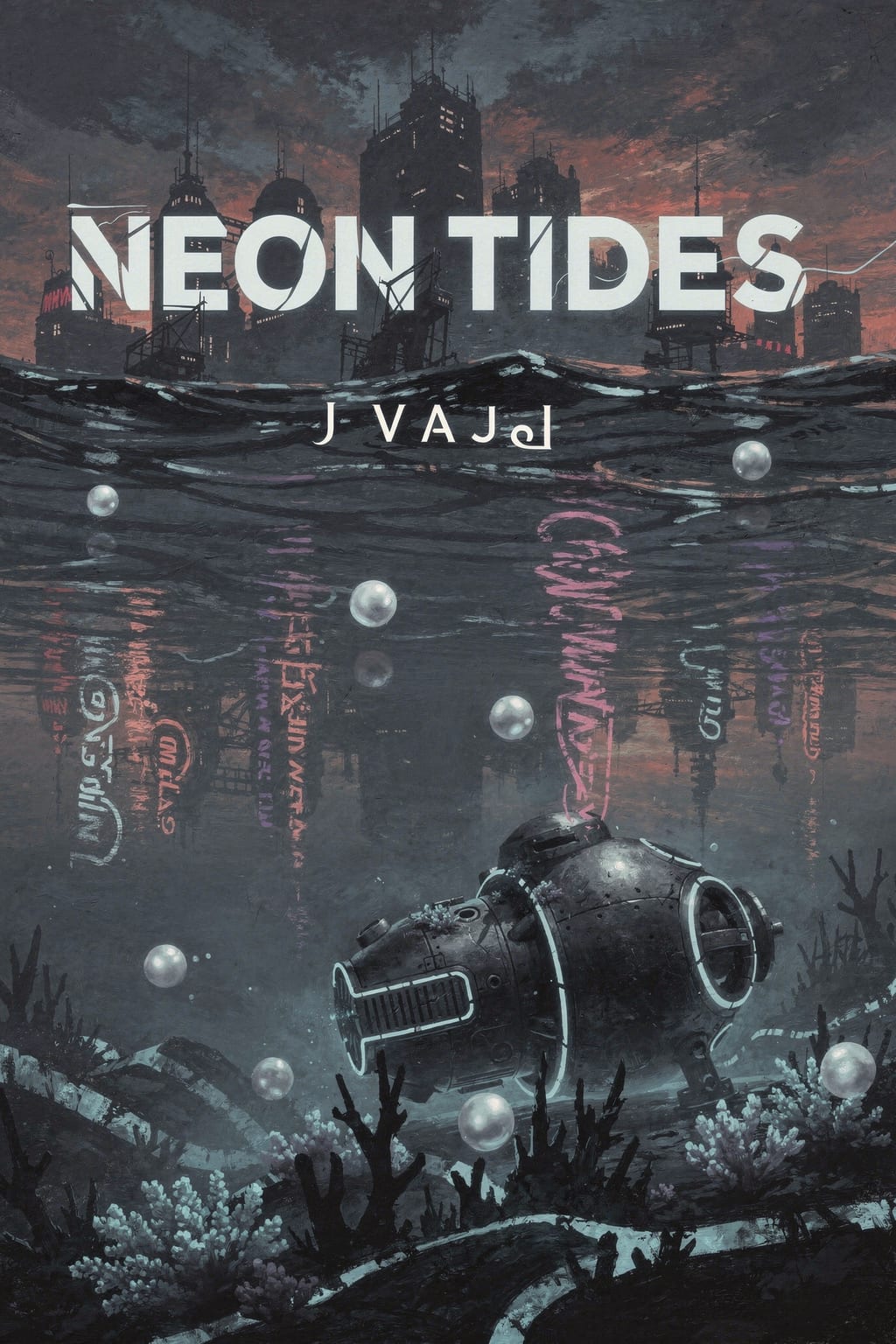
About This Novel
Neon Tides is a cyberpunk · hydro-punk novel, following Here are the detailed character profiles for Neon Tides, listed in order of importance:, .
Opening Line
"Depth: +2m."
Chapter 1
"The Storm Was a Liar"Depth: +2m. The storm was a liar—it came in quiet, and Maren didn’t trust it.
Rain needled the Basilica Market’s glass ceiling in silver streaks, blurring the neon halos of floating vendors. The drowned piazza yawned beneath the transparent floor, its ghostly columns etched in the pale glow of submerged mosaics—saints and angels bleached to bone by decades of salt. The market moved like a wounded animal above it, twitching and restless beneath the weight of the coming weather, the air thick with diesel, wet stone, and the salt-sweet rot of the city below.
Maren moved through the crowd the way a current threads through reef—without thought, without apology, shoulders angled to slip between bodies, eyes scanning without appearing to look. Storms meant the Coastal Authority’s patrols would run thin, and thin patrols meant business could be done. The shadow market had its own tide charts, and they had nothing to do with the moon. She passed a stall selling counterfeit pearl-cores, their glow suspiciously dim. She passed a woman trading oxygen ration tokens for the location of a wreck three miles out. She passed children playing in the shallows at the nave’s edge, their skin faintly luminous with pearl-dust, their laughter bright and hollow as struck glass.
Her boots sloshed through ankle-deep water as she wove between barges moored in the nave, hulls bristling with hydro-knives and smuggled reef-core. The air hummed with static from a hundred competing frequencies—Syndicate patrols, black-market sonar, the tinny ghost of a cathedral choir looped on a cracked server. A vendor hawked pressure seals; another offered bioluminescent ink, the patterns drifting like living tide charts across the skin of his forearms.
Maren checked her wrist—not for the time, but for the pressure reading. The storm was pushing water up through the city’s understructure, straining the market’s moorings. She had maybe twenty minutes before the rising water forced the market to disperse.
Twenty minutes was plenty.
She found Petrov where he always was—tucked into a shadowed alcove near the north transept, his barge painted the same grey as the water around it. He was a thin man with the nervous energy of a creature that had evolved to flee rather than fight, his oilskin coat sweating rust. When he saw her, his eyes flicked with the desperate relief of a man who had begun to fear he’d been abandoned.
“*Finalmente*,” he hissed. “You’re late.”
“You’re still here,” Maren replied. “That means I’m not late. That means you had nowhere else to go.”
His mouth tightened, but he didn’t argue. He gestured to the crate chained to a pillar beside the confessionals—a rectangular box of corroded metal, its surface covered in the hieroglyphics of old-world shipping labels. The seals were intact, which was either a good sign or a very bad one.
“Insurance,” he said, thumb jerking at the crate. “Against the Syndicate’s *protection*. They’ve been squeezing the independents, demanding a cut of every salvage. This is leverage. Something they’ll want badly enough to back off.”
Maren knelt, gloved hands skimming the lock’s pressure seals. Salt-crusted gears. Hydraulic hiss. The metal was cold, colder than it should have been in the humid heat of the Basilica. And beneath her fingers, something was humming—a vibration so faint it lived in the bone, not the air—a low pull that settled deep in her jaw.
“You’re leaking,” she muttered, nodding at the damp stain spreading down his sleeve.
Petrov glanced at it, then away. “*Bastardi* cut the deal early. They’re here.”
“The Syndicate knows it’s missing,” Maren said. It wasn’t a question.
His laugh was a brittle thing, cracking at the edges. “They know everything. That’s the problem with stealing from people who own the information trade. They find out about it before you’ve even decided to do it.”
“Then why did you steal it?”
“Because I’m tired.” The words came out flat, stripped of emotion. “I’m tired of watching them take and take and take. I’m tired of paying tribute for the right to breathe their air and drink their water. I’m tired of being afraid.”
Maren said nothing. She understood tired. She understood afraid. They were the twin engines of the drowned world, the currents that moved everything beneath the surface.
She reached into her belt and pulled out a string of pearls—bioluminescent spheres the size of her thumbnail, pulsing with soft blue light. The currency of the shadow market, harvested from creatures growing scarcer every year. She pressed them into Petrov’s palm.
“Half now,” she said. “The other half when I confirm what’s in the crate.”
His fingers closed around the pearls, but he didn’t look relieved. He looked like a man who’d just realized the ground beneath him was thinner than he’d thought.
“Be careful with it,” he said. “Whatever it is, it’s not natural. You can feel it, can’t you? In your teeth?”
Maren could. The hum had intensified as she’d knelt beside the crate, vibrating through her like a held note on a wire she couldn't find. It felt like standing too close to a hydro-generator, like the pressure building before a dive.
“I can handle it,” she said.
Petrov’s eyes met hers, and for a moment, she saw something in them she hadn’t expected: pity.
“That’s what your mother said,” he told her. “Right before she went down.”
Maren’s hand moved before she could stop it, grabbing Petrov by the collar and pulling him close. The pearls scattered across the deck, rolling between the boards and into the water below.
“Don’t,” she said, her voice low and dangerous. “Don’t you dare talk about my mother.”
Petrov’s face was white, but he didn’t look away. “I’m not trying to hurt you, Maren. I’m trying to warn you. This thing—whatever it is—it’s connected to her. To what she was working on. I’ve heard things.”
“What things?”
“Things that don’t make sense.” He shook his head, a small, desperate motion. “Talk of machines that control the currents. Talk of something hidden because it was too dangerous to use. Talk of a woman who went down to the Trench Station and never came back, and no one knows why.”
The first scream tore through the market before Maren could answer.
It cut through the rain-hiss like a blade, high and sharp and terrified, followed by the unmistakable crack of a sonic rifle and the roar of a hover-engine. The neon signs flickered. Vendors froze mid-transaction, heads turning toward the entrance like a school of fish sensing a predator.
“Syndicate!” someone shouted, and the market dissolved into chaos.
Maren didn’t stop to think. Thinking was a luxury she couldn’t afford in moments like this. She moved, her body responding with the muscle memory of a hundred similar escapes, her hand snapping the crate’s chain with a sharp twist of hydraulic cutters. The crate hit the deck with a weight that jarred her arms, and the hum in her teeth surged.
Petrov was already backing away, his eyes wide and white. “Get it out of here,” he said. “Get it somewhere safe. And whatever you do—” He paused, and his face twisted with something that might have been regret. “Don’t touch it. Not with your bare hands.”
He turned and disappeared into the surging crowd before Maren could ask anything else, his thin frame swallowed by the shifting mass of bodies.
Around her, the market was disintegrating. Vendors cut moorings, abandoned goods, dove into the water to escape. Barges collided, hulls grinding together with sounds like breaking bones. The generators died as they were shut down, plunging the cathedral into darkness lit only by the faint glow of the mosaic floor and the pale wake of panicked swimmers. A stun round sizzled past Maren’s head, close enough to singe the air, and she ducked, hauling the crate toward the flooded transept.
Syndicate enforcers surged through the dispersing market like a tide, their visors glowing the sickly green of active sonar scans. They moved with the calm precision of people who had done this before, who knew the chaos would do most of their work for them. And at their head, moving through the crowd with the grace of water finding its level, was a woman with a shaved head and a constellation of small tattoos across her skull.
Soraya Chen.
Maren recognized her the way a diver recognizes a rip current—by the cold certainty in her gut. She’d crossed paths with Chen before, had always managed to stay one step ahead. But Chen was relentless, and she never forgot a face. Her eyes swept the nave, missing nothing, and Maren knew she had seconds before those eyes found her.
She made a decision.
The crate was too heavy to run with, too conspicuous to carry through the chaos. She dragged it to the edge of the flooded transept, where the water lapped against the glass floor’s lip, and she pushed it over.
The crate hit the surface with a splash that echoed through the nave. The buoyancy collar she’d strapped on in the same motion caught it, bobbing it against the far wall like a cork. Maren didn’t wait to see who noticed. She turned and ran, her footsteps loud on the stone floor, her lungs burning.
She knew the Basilica better than most—had explored its flooded corridors as a child, mapped its hidden passages and dead ends in the years since. The main nave would be the first place the Syndicate looked. Her best chance was up, into the galleries that had once held choir stalls and now held squatters and storage.
She took the stairs two at a time, the echoes of her pursuit ringing below. Behind her, she heard shouts, the crack of more rifles, the splash of bodies hitting the water.
“Corvane!” The voice cut through the chaos, sharp and cold and familiar. “Maren Corvane! We know it was you! Come out, and we’ll make it quick!”
Maren ducked into the shadows of the gallery, pressing herself against the damp stone wall. Her pulse hammered so hard she could hear it over the rain, her hands slick with sweat. She could hear Chen’s footsteps below, moving through the nave with the calm confidence of a predator who knew her prey was cornered.
“Don’t make this harder than it needs to be,” Chen called out. “You know how this works. You give us what we want, and we forget we ever saw you. The alternative is much less pleasant.”
Maren’s mind raced, mapping the possibilities. The gallery ran along the north wall, ending at a collapsed section that opened into the flooded crypt. From there, she could swim to the service tunnels that connected to the outer canals. But the route required her to go through the water, and the crate—
She stopped. The crate was in the transept, bobbing against the far wall. She’d pushed it over the edge expecting to retrieve it, but the enforcers had cut her off. It was gone now, or as good as.
She’d lost it.
The thought hit her like a pressure change, a hollow pop in her chest. Twelve years of keeping her family afloat, of trading secrets for pearls, of never owing anyone anything—and she’d just thrown it all away for a crate she couldn’t even keep.
Below, Chen’s voice rang out: “She’s in the water! Find her!”
Maren didn’t wait to hear more. She ran along the gallery, her footsteps loud on the stone, and threw herself through the collapsed section into the black water of the crypt.
The cold was a shock, a fist around her chest. She surfaced, gasping, and struck out through the darkness toward the service tunnel she knew was there. The water was rising, filling the crypt faster than she’d expected, and she had to duck to avoid the ceiling as she swam.
The tunnel was narrow, barely wide enough for her body, and the darkness was absolute. Maren navigated by touch, her hands finding the rough stone walls, her feet kicking against debris accumulated over decades of flooding. She was halfway through when she heard the splash behind her.
She didn’t turn. She didn’t stop. She just swam faster, her lungs burning, her muscles screaming, until the tunnel opened into the larger chamber of the old crypt—where the doges had been buried centuries ago, their tombs long looted. There was an opening in the ceiling, a rusted grate that led to the canal above.
She pushed herself up, felt the grate give way under her weight, and pulled herself through into the cold, rain-soaked air of the canal.
The storm had intensified while she was below. Rain hammered the water’s surface, and waves were building, rocking the boats moored along the canal. Maren dragged herself onto a nearby landing and lay there for a moment, gasping, rain streaming down her face.
She’d made it. She was alive.
But she’d lost the crate. And Soraya Chen had seen her face.
The surge of exhilaration she’d expected didn’t come. Instead there was only the hollow weight of failure, the familiar ache of having risked everything and come away with nothing.
She pushed the thought aside. She needed to move. The Syndicate would close the canals soon, and she needed to be somewhere else when they did.
She hauled herself to her feet and began to make her way through the narrow streets of the drowned city, the rain hammering around her, the storm’s static filling her ears. She kept to the shadows, moving hugging the walls the way her father had taught her, spine low, shoulders turned to the narrowest profile.
The *Suspended Note* was moored in the shadow of a ruined bell tower, its hull rising and falling with the swell. The cargo lifter had seen better days—her father had bought it when Maren was a child, and it had been held together with patchwork and determination ever since. The walls pulsed with bioluminescent moss that fed on medical waste from Zyla’s oxygen filtration unit. Her father’s charts wallpapered every surface—flood maps, pressure gradients, tide tables annotated in his cramped hand. And in the margins, her mother’s poetry, written in a script that seemed to flow like water.
*The sea doesn’t drown. It remembers.*
Maren sealed the hatch behind her and collapsed against the wall, letting the hull's creak settle around her. The cabin was dim, lit only by the soft glow of the moss and the steady pulse of Zyla’s oxygen unit in the next room. She could hear her sister breathing—the wet, labored rhythm she'd long since stopped hearing as separate from the hull's breathing.
She should check on her. She should eat something. She should figure out what the hell she was going to do now that she’d lost the crate and gained the Syndicate’s attention.
But she couldn’t move. She sat there, rain-drenched and shaking, staring at nothing.
And then she felt it.
A vibration. A hum, so faint it was more like a memory than a sensation—but it was there, resonating through the old scar along her jaw and into places she didn't have names for.
She turned her head slowly.
The crate was sitting against the far wall of the cabin.
Maren stared at it, her heart suddenly pounding. It couldn’t be. She’d left it in the transept. She’d watched it bob against the far wall. She’d—
But there it was. Corroded metal, faded shipping labels, intact seals. The same crate she’d hauled through the market, the same crate she’d abandoned in the flooded nave.
The hum thickened as she approached, settling into the roots of her teeth and the cage of her ribs. She crouched beside it, running her fingers over the surface. The metal burned with cold, sweating condensation in the cabin's wet heat.
She didn’t remember bringing it aboard.
The thought was a cold stone in her gut. She checked her memory, trying to piece together the sequence—the escape through the crypt, the swim through the tunnel, the climb through the grate. She remembered the landing. She remembered the walk through the streets.
She didn’t remember the crate.
But it was here. And the hum was getting louder.
Maren stared at the crate for a long moment, remembering Petrov’s warning. *Don’t touch it. Not with your bare hands.*
She should find a way to secure it. Hide it. Figure out what it was worth and who would pay the most for it. That was what she did. That was how she survived.
But the hum was like a voice, calling to her. And she couldn’t help but wonder what her mother had been doing with something like this.
The thought of her mother sent the old ache through her chest, a pain she’d learned to carry like an old injury. Elia Corvane had been dead for twelve years, and Maren still hadn’t forgiven her for it.
She reached for the latch.
The lid swung open, and the hum became a sound—a note so low and pure it seemed to vibrate through the very structure of the boat. The light that emerged was soft and green, like sunlight filtered through deep water.
The device inside was beautiful.
It was made of coral-bronze, a material Maren had only heard of in whispers and legends. The metal had a living quality to it, as if it had grown rather than been forged, its surface webbed with grooves that rippled like water over sand. It was shaped like a compass—a circular disc with a needle at its center—but the needle didn’t point north. It pointed down.
Maren reached out to touch it.
The moment her fingers made contact, the world dissolved.
She was no longer on the *Suspended Note*. She was in the deep, in the lightless zone where no light had reached for millennia, where the pressure was so immense it felt like being held in the fist of a god. The cold was absolute, the darkness complete.
And she was not alone.
Something moved in the darkness ahead of her, something vast and ancient, something that had been swimming these depths since before humanity had crawled out of the sea. She could feel it approaching—the displacement of water, the mass of its attention bearing down on her like depth itself.
And then she saw it.
The creature was enormous, larger than any whale, larger than any ship, larger than anything Maren had ever imagined. Its body was laced with living light—patterns that pulsed and remade themselves in the same rhythms as the device she’d touched. Its eyes were the size of her boat, and they were ancient—filled with a wisdom that made her feel small and young and terribly fragile.
It opened its mouth, and a sound emerged—not a roar, not a song, but something in between. A whale-song that bypassed her ears entirely and arrived somewhere behind thought.
*Who are you?*
The voice was not a voice. It was a pattern of light, a shift in the current, a vibration in the water. But Maren understood it.
She opened her mouth to answer, but before she could speak, the vision shattered.
She was back on the *Suspended Note*, gasping on the floor, her hand still touching the coral-bronze device. The hum had stopped, replaced by a ringing silence that made her ears feel stuffed with cotton. Her heart was pounding. Her skin was slick with sweat. And she could still feel the pressure of the creature’s gaze, still hear the echo of its question.
*Who are you?*
Maren pulled her hand back, staring at the device with a mixture of awe and terror. Her fingers were tingling, and she noticed with a distant sense of horror that the patterns on the device’s surface had changed, shifting to mirror the bioluminescent patterns she’d seen on the creature’s skin.
She needed to get rid of it. She needed to find Petrov and give him back his cursed insurance. She needed to pretend she’d never touched it.
But she couldn’t move.
She sat there, frozen, trying to slow her breathing, trying to convince herself that what she’d seen was just a hallucination—a side effect of stress and exhaustion. The transfer had been dangerous. She’d pushed herself too hard. That was all.
And then she felt it.
A presence.
Not the creature from her vision, but something closer, something watching. She could feel eyes on her, could feel the weight of another consciousness pressing against the edges of her awareness.
She turned slowly, her heart in her throat.
Through the porthole, illuminated by the dim glow of the cabin’s bioluminescent moss, a face stared back at her.
It was a woman’s face, pale and sharp-featured, with a shaved head covered in a constellation of small tattoos. Her eyes—dark and calm and utterly without mercy—were fixed on Maren with the patience of a hunter who knew her prey had nowhere left to run.
Soraya Chen smiled.
Then she was gone, dissolving into the darkness of the water, leaving Maren alone with the device and the echo of the creature’s question.
*Who are you?*
From the next room, Zyla coughed—a wet, rattling sound that Maren could have kept time by. The oxygen filtration unit hissed, cycling through another laborious breath.
Maren stared at her hand, still tingling from the contact. The glow had faded, but she could still feel the device humming in the air, a low note lodged somewhere beneath her skin.
She didn’t know the answer to the creature’s question anymore.
Somewhere, the tide shifted.
All 16 Chapters
Frequently Asked
What genre is Neon Tides?
Neon Tides is a Cyberpunk · Hydro-Punk novel.
How long is Neon Tides?
Neon Tides is 68,818 words across 16 chapters, roughly 98% the length of a standard published novel.
How was this novel written?
Neon Tides is a collaboration between humans and AI on Whimsy Ink. A human and AI collaborate on a concept and write the book together. Every novel is unique.
Who are the main characters in Neon Tides?
The main characters include Here are the detailed character profiles for Neon Tides, listed in order of importance: (), MAREN CORVANE (Protagonist), DRI (ADRIAO "DRI" VELASQUEZ) (Ally / Love Interest).
Want a novel like this?
Describe it. We'll write it.
✨ Dream Your Own