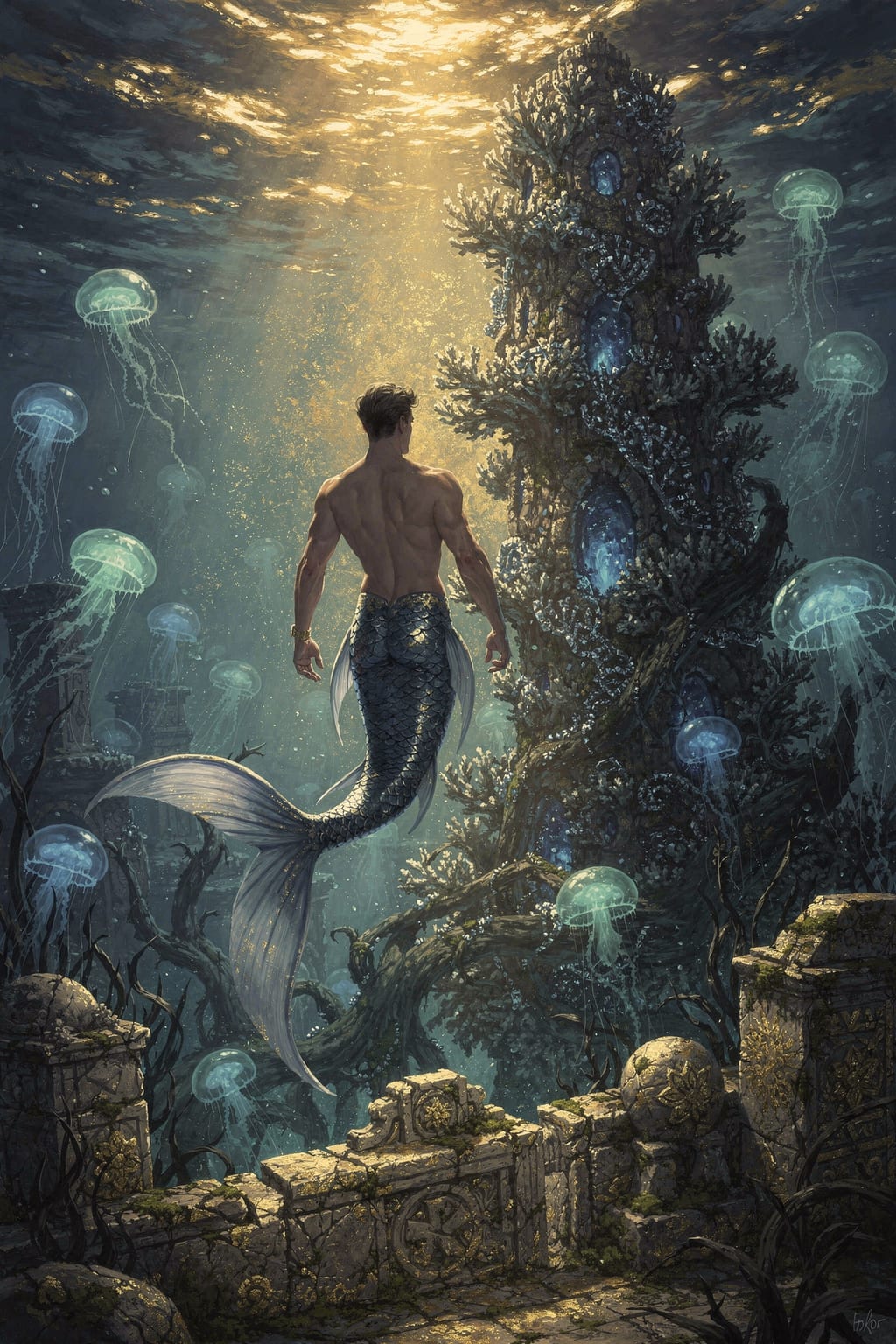
The Great Gatsby With Merpeople
✨ Start ReadingAbout This Novel
The Great Gatsby With Merpeople is a fairy tale retelling · literary romance with speculative elements novel, following Here are the detailed character profiles for the key figures in The Deep Blue Suitor:, .
Opening Line
"The water that autumn was warmer than it should have been—a strange current pushing up from the south, carrying the memory of distant storms."
Chapter 1
"The Descent"The water that autumn was warmer than it should have been—a strange current pushing up from the south, carrying the memory of distant storms. Even on land you could feel it, the air thick and salt-laden, the light through the windows of my sister's house taking on a greenish cast that made everything look submerged. I remember thinking, before I knew anything about Atlantis, that the world was already half under water. I didn't know how right I was.
In my younger and more vulnerable years my father gave me some advice that I've been turning over in my mind ever since.
"Whenever you feel like criticizing anyone," he told me, "just remember that all the people in this world haven't had the advantages that you've had."
He didn't say merpeople. He didn't need to.
The reservation of judgment was a promise I made with the easy confidence of a man who has never been tested. I was thirty, restless, and convinced that the world contained wonders I had not yet catalogued. The war had ended. My engagement had ended. My career as a bond salesman on Wall Street had ended—or rather, had never properly begun, a distinction that mattered only to my creditors. What remained was a vague sense that I had been living my life in a key that was slightly off, a melody I couldn't quite place, and that somewhere—in some other country, some other element—the true music was playing.
So when my cousin Daisy's husband mentioned, with the condescension he reserved for anyone not born into his exact zip code, that he knew a man at the *Atlantic* who could get me a press credential for the descent stations, I did not say no.
"You'll come back changed," Tom Buchanan said, not looking at me. He was mixing a gin rickey with the air of a man performing a surgical procedure. "Everyone does. That's the thing they don't tell you about the deep. You go down human, you come back—" He shrugged, a gesture that made his massive shoulders roll like a tide. "Something else."
"You make it sound like a horror story."
"It is," he said, and drained his glass. "It's a horror story and a gold rush and a circus, and the mer are the ones running all three. You think they're selling you a glimpse of their civilization. What they're actually selling you is the rope to hang yourself with."
This from a man whose private descent facility was rumored to be the most luxurious on the Eastern Seaboard.
Daisy caught my eye across the table and smiled—that particular smile she had, as if we were sharing a joke that Tom would never be clever enough to understand. "Don't let him frighten you, Nick. The deep is beautiful. I've seen it." She paused, and something flickered behind her eyes, there and gone. "Parts of it."
"How deep did you go?"
"Oh, not very. Just the Shallows, really. The parts where the light still reaches." She laughed, and the sound was bright and weightless, something that floated. "I've never had the constitution for the dark. Some people are built for it. Some people—" She stopped, and for a moment her face went slack, as if she'd forgotten what she was saying.
"Darling," Tom said, not unkindly, "you're drifting."
"I'm always drifting," she said, and the brightness returned, almost too bright. "It's my natural state. I'm like a boat that's slipped its mooring. The tide takes me where it will."
Tom snorted. "The tide takes you wherever I tell it to."
She laughed at that, and so did he, and the moment passed. But I noted the shape of it—the way her laugh came a half-second too late, the way his hand found her wrist and held it a moment longer than affection required. I was thirty years old and freshly heartbroken, and I told myself I was imagining the undertow beneath the surface of their perfect marriage.
I told myself a lot of things that summer.
---
The descent station at Port Elizabeth rose from the harbor like a concrete afterthought—all right angles and utilitarian gray, the kind of building designed by men who believed that beauty was a form of deception. The queue stretched around the block, a river of people carrying the mismatched luggage of the desperate and the curious: pressure suits in canvas bags, canisters of breathing apparatus, waterproof journals bound in oilskin. A woman ahead of me held a child who was crying—the thin, exhausted wail of a creature that has been waiting too long—and I watched a station official approach her with the practiced sympathy of a man who has delivered the same speech a thousand times.
"Forms," he said. "You'll need to complete the forms. Section A, Section B, Section C. Have you completed the medical screening?"
"She's tired," the woman said. "We've been waiting since dawn."
"The screening is mandatory. It's for your protection." The official's voice had the flat, uninflected quality of something recorded. "The Change is not a joke, ma'am. We're not in the business of letting people descend and come back—altered."
"Altered," the woman repeated. She looked at her child, then at the gray water of the harbor. "What if I want to be altered?"
The official's face folded into disapproval. "That's not the kind of thing we recommend putting in writing, ma'am."
I moved through the queue with the frictionless privilege of the press credential—a laminated card that seemed to open doors and close faces simultaneously. The officials looked at it, looked at me, and decided I was not worth the effort of suspicion. I was processed. I was screened. I was prodded and questioned and made to sign documents whose language I did not fully parse, waivers that seemed to cover everything from drowning to "spontaneous biological reorganization."
The medical screening was conducted by a man who never looked at me. His eyes remained fixed on a monitor that displayed—as far as I could tell—my vital signs rendered as a series of undulating waves.
"Any history of respiratory conditions?"
"No."
"Epilepsy? Seizure disorders? Any tendency toward—" he paused, consulting his screen—"compulsive water-seeking behavior?"
"I grew up near the lake. I liked to swim."
The man's eyes finally lifted. They were pale, the color of the sky on an overcast day, and they regarded me with something that might have been pity. "Everyone says that," he said. "Everyone who grew up near water says they liked to swim. Do you know what they say after? After they've been down and come back up?"
I waited.
"They say they can still feel it. The pressure. The weight of the water on their skin. They say it feels like being held." He returned his gaze to the monitor. "You're cleared. Try not to like it too much."
---
The descent itself was not what I expected.
I had imagined a gradual sinking, a slow slide into darkness like a coin dropping through oil. Instead, there was the lock—a steel chamber the size of an elevator, with a bench along one wall and a porthole that showed nothing but the green-black water of the harbor. The officials sealed the door with the casual efficiency of men closing a vault. There were four of us inside: myself, an elderly couple who held hands with the desperation of people about to undergo something they did not understand, and a young woman in a tailored suit who sat perfectly still, her eyes closed, her lips moving silently as if in prayer.
The water began to rise.
It came from below, seeping through the grate in the floor with a sound like a sigh. The elderly woman gasped and pressed herself against the wall. Her husband made soothing noises, but his knuckles were white where he gripped the rail.
"First time?" the young woman asked, without opening her eyes.
"Yes," I said.
"It gets easier." She opened her eyes then, and I saw that they were not quite human—the pupils slightly too large, the irises shot through with flecks of silver that caught the light like scales. "Or it gets harder. I haven't decided which."
The water reached my waist. Then my chest. The cold was not the shock I expected—it was more like a gradual embrace, the water pressing against me from all sides, finding the spaces between my clothes and filling them with its particular weight. The elderly woman had stopped gasping. She was crying, silently, tears running down her face and mixing with the rising water.
"Breathe," her husband said. "Just breathe."
The water reached my chin. I tilted my head back, my last instinct as an air-breather asserting itself. The ceiling of the lock was close enough to touch, and I watched it approach with the slow-dawning dread of a man discovering, far too late, the limits of his own lungs.
The young woman in the tailored suit reached over and took my hand. Her grip was cool and certain.
"Don't fight it," she said. "That's the first thing they teach you. Fighting it is how you drown."
The water closed over my face.
I have never been able to describe what happened next in a way that satisfies anyone who has not experienced it. The pressure hit first—a weight that seemed to compress me from all directions, squeezing the air from my lungs and replacing it with something that was not quite breath but was, somehow, sufficient. The darkness followed, absolute and complete, a blackness so total that I felt my eyes strain against it, searching for a light that did not exist.
And then—light.
It came from below, a soft luminescence that grew as we sank, and with it the pressure eased, the darkness thinned, and I found that I could breathe. Not comfortably, not naturally, but adequately. The apparatus strapped to my face hissed and gurgled, feeding me a mixture that tasted of salt and something metallic, but it worked. I was alive. I was breathing. I was descending into a world that had existed beneath my feet my entire life without my ever having known it.
The lock opened, and I swam out into Atlantis.
---
I have seen the cathedrals of Europe. I have stood at the rim of the Grand Canyon and felt the particular vertigo of geological time. I have watched the sun set over the Pacific and understood, for a moment, why men have always believed in gods. But nothing prepared me for the sight of a city that had been built beneath the sea by creatures who had never known the tyranny of gravity.
The towers rose like coral cathedrals, their surfaces alive with light—not the harsh electric glow of the surface world, but something softer, more organic. Bioluminescent gardens grew along the walls in cascades of blue and green and silver, pulsing with a rhythm that seemed to match the current itself. The water was not dark here. It was shot through with shafts of light that filtered down from above, shifting and dancing as the surface moved, and in that light I saw the mer for the first time.
They moved like music.
That was my first thought, and it has never quite left me. They moved like music—their tails catching the light as they swam, their bodies curving and flowing with an ease that made my own clumsy strokes feel like a form of violence. They were beautiful, and they were strange, and they were everywhere, darting between the towers and the gardens and the great open plazas that connected the city like the arteries of some vast, living creature.
I surfaced—if it could be called surfacing—in a chamber that seemed designed for the particular purpose of disorienting land-dwellers. The floor was a mosaic of shell and stone, depicting scenes I could not quite parse: mer and surface-dwellers intertwined in poses that might have been embrace or combat. The ceiling was a dome of glass, and through it I could see the city rising above me, tower after tower ascending toward the distant, shimmering light of the surface.
"First time."
I turned to find a mer waiting for me—an older specimen, his scales faded to a gray that caught the light like tarnished silver, his face lined with the lined patience of someone who has watched too many newcomers make the same mistakes.
"Is it that obvious?"
"You're floating," he said. "You land-dwellers always float. It takes a while to learn how to hold yourself down." He extended a hand—webbed, I noticed, the fingers connected by a thin membrane that shimmered faintly—and helped me to the floor. "Name's Sullivan. I run the café down the way. You look like you could use a drink and a lecture."
"I could use both," I admitted.
---
The café was a small establishment carved into the base of one of the towers, its walls lined with shelves of curiosities that I later learned were salvaged from surface wrecks—a ship's wheel, a brass sextant, a photograph in a broken frame showing a woman in a dress that had gone out of style decades before I was born. The tables were carved from what appeared to be whalebone, polished to a smoothness that caught the light, and the seating consisted of cushions of some plant material that gave slightly beneath me as I sat.
Sullivan brought me a cup of something that steamed—steamed, underwater, a fact I filed away for later contemplation—and sat across from me with the settled ease of a man about to deliver a monologue.
"So," he said. "You're here to write a book."
"How did you know?"
"Everyone's here to write a book," he said. "Or to find themselves. Or to lose themselves. Or to get rich. Or to get lost. The ones who are honest about it are the ones who say they're here to see the Lantern House."
"The Lantern House?"
He gestured with his chin, and I turned to look through the window of the café. The view opened onto a plaza, and beyond the plaza, rising above the other towers like a cathedral among chapels, I saw it.
The building was impossibly tall, impossibly bright. Its walls were glass and coral, fused in a way that seemed to defy both nature and architecture, and from every surface light poured—not the soft bioluminescence of the rest of the city, but something brighter, almost harsh, as if the building were trying to compete with the sun itself. It rose and rose, past the upper reaches of the other towers, past the point where I had thought the city ended, and at its peak—
At its peak, a single point of green light, burning steadily through the water.
"That's Gatsby's place," Sullivan said, and there was something in his voice I couldn't quite identify. Awe, perhaps. Or wariness. Or both. "Jay Gatsby. You've heard of him."
"I haven't."
"You will." Sullivan leaned back, his tail flicking with what I took to be satisfaction. "Everyone hears of Gatsby eventually. He's the one who throws the parties."
"Parties?"
"You haven't heard about the parties." It wasn't a question. Sullivan's face had taken on the gleaming expression of a man who has discovered that he knows something you don't, and intends to savor the discovery. "Every week, sometimes twice a week, the Lantern House opens its doors to anyone who can swim. The tide-pool terrace, they call it. Bioluminescent gardens. Music—real music, from the surface, played by musicians in air-bubbles. Food that costs more than most mer make in a year. And Gatsby—" Sullivan paused, letting the name hang in the water between us. "Gatsby stands at the center of it all, watching. Just watching."
"Watching what?"
"The door," Sullivan said. "He's always watching the door. Like he's waiting for someone."
The café had grown quiet. I realized, belatedly, that the other patrons—a mix of mer and surface-dwellers, I now saw—had been listening to our conversation with the attention of people who have heard a story many times but are always willing to hear it again.
"Who's he waiting for?" I asked.
Sullivan shrugged, a gesture that looked strange performed by a creature without shoulders in the traditional sense. "No one knows. Some say it's a woman. Some say it's a business rival. Some say he's waiting for the sea to give back something it took from him." He leaned forward, lowering his voice. "I knew a mer who went to one of the parties. Said he saw Gatsby standing at the edge of the terrace, staring up at the surface. Just staring. For an hour. When someone asked him what he was looking at, he said—" Sullivan paused, and I could see him savoring the memory of the story. "He said, 'I'm looking at the light. The green light. It's at the end of a dock, and it's the most beautiful thing I've ever seen.'"
"The green light," I repeated, and I turned to look again at the tower, at that single point of emerald burning through the dark water.
"The green light," Sullivan agreed. "The one at the top of his house. He built it himself—had it shipped down from the surface in pieces, reassembled it with his own hands. Cost him a fortune, they say. More than a fortune."
"Why?"
"No one knows." Sullivan's voice had dropped to something approaching reverence. "But everyone's got a theory. The most popular one is that it's a signal. A message. Something he's sending up to the surface, to someone who might be watching."
"Watching from where?"
"The surface," Sullivan said simply. "Someone on the surface, looking down at the water, seeing that green light burning through the waves. Someone who might see it and know that Gatsby is still here. Still waiting."
I looked at the tower again. The green light burned steady and patient, and I thought about the woman in the harbor, the one who had wanted to be altered, and the official who had told her that was not the kind of thing to put in writing. I thought about Tom Buchanan's warning—that you go down human and come back something else. I thought about Daisy, and the smile that had flickered and faded when she talked about the Shallows, and the way she had said *some people are built for it, some people aren't*, with a longing she had tried, too late, to hide.
"I should get to my rooms," I said, standing. "I've taken enough of your time."
"Stay as long as you like," Sullivan said. "The water's fine." He paused, and his face went still. "But I'll give you one piece of advice, Mr.—"
"Carraway. Nick Carraway."
"Mr. Carraway. Stay away from the Lantern House. The parties are magnificent, but they're not what they seem. Nothing about Gatsby is what he seems." He leaned forward, and his voice dropped to a whisper. "They say he came from nothing. From the Deep Warrens, the lowest part of the city. They say he made his fortune in ways that don't bear close examination. They say—" He stopped, and I saw something flicker in his eyes. Fear, perhaps. Or calculation. "They say people who cross him have a way of disappearing."
"Disappearing?"
"Relocating," Sullivan said, and the word was heavy with meaning. "They decide to pursue other interests. Somewhere far from here. And they're never seen again."
I should have been alarmed. I should have taken the warning for what it was—a sign that I was entering a world where the rules were different, where the currents ran deeper and darker than I could possibly understand. Instead, I felt something else entirely.
I felt curiosity.
"Thank you for the warning," I said. "And the drink."
Sullivan nodded, but his eyes followed me as I swam—I was learning, slowly, the ungainly strokes required to navigate the water—toward the door. Just before I reached it, he called out:
"Mr. Carraway!"
I turned.
"If you do meet him—Gatsby, I mean—" Sullivan's face was unreadable. "Ask him about the Shallows. Ask him what happened there. And whatever he tells you, remember: he's been planning this for a long time. Longer than anyone knows."
I nodded, though I didn't understand, and swam out into the city.
---
My rooms were in a modest building on the western edge of the Upper Reaches, a short distance from the Lantern House. I had been told, when the arrangements were made, that I had been fortunate to secure such accommodations—that housing in Atlantis was scarce, particularly for surface-dwellers, and that the building I had been assigned was normally reserved for visiting dignitaries and scholars of the mer civilization.
I did not question my good fortune. I was too overwhelmed by the strangeness of everything around me.
The rooms themselves were a marvel of adaptation. The walls were lined with a material that seemed to breathe, filtering the water and maintaining a temperature that was comfortable despite the ambient cold of the depths. The furniture was weighted—I learned this when I attempted to sit on a chair and found myself drifting upward, caught in a current that I had not yet learned to navigate. The windows were enormous, spanning the full height of the room, and through them I could see the city spread out below me like a map of some impossible civilization.
And above me, to the west, the Lantern House rose like a challenge to the sun itself.
I stood at the window for a long time, watching the light play across the towers, watching the mer move through the currents with the grace of creatures who had never known the weight of air. I thought about the descent station, and the official who had warned me not to like it too much. I thought about Sullivan's stories, and the fear that had flickered behind his eyes when he spoke of Gatsby. I thought about Tom Buchanan, and the particular condescension with which he had spoken of the deep, and Daisy, and the smile that never quite reached her eyes.
And I thought about the green light.
It burned at the top of the Lantern House—a single point of emerald that seemed to pulse with its own rhythm, steady and patient and impossibly bright. I watched it, the way one watches a flame in a dark room, and I understood—without quite knowing why—that it was the most important thing I had seen since I arrived.
The water was warm that night. A current had moved in from the south, carrying with it the memory of distant storms, and it pressed against the windows of my room with a gentle, insistent rhythm. I stood in the darkness, watching the green light burn, and I felt the loneliness of a man who has traveled far from everything he knows and found, in the distance, a light that seems to promise something he cannot quite name.
I closed my journal, and I wrote:
*There is a man in the tower next door who is waiting for something. I don't know what. But I suspect it will be the most important thing I never understand.*
Outside, the green light burned on. And somewhere in the deep, in a tower of glass and coral, a man I had never met was watching the surface, waiting for a woman who could not breathe his water.
I did not know, then, what I would become. None of us ever do.
All 18 Chapters
Frequently Asked
What genre is The Great Gatsby With Merpeople?
The Great Gatsby With Merpeople is a Fairy Tale Retelling · Literary Romance with Speculative Elements novel.
How long is The Great Gatsby With Merpeople?
The Great Gatsby With Merpeople is 75,769 words across 18 chapters, roughly 108% the length of a standard published novel.
How was this novel written?
The Great Gatsby With Merpeople is a collaboration between humans and AI on Whimsy Ink. A human and AI collaborate on a concept and write the book together. Every novel is unique.
Who are the main characters in The Great Gatsby With Merpeople?
The main characters include Here are the detailed character profiles for the key figures in The Deep Blue Suitor: (), Jay Gatsby (Protagonist/Antagonist (unreliable)), Daisy Buchanan (Love Interest/Tragic Figure).
Want a novel like this?
Describe it. We'll write it.
✨ Dream Your Own