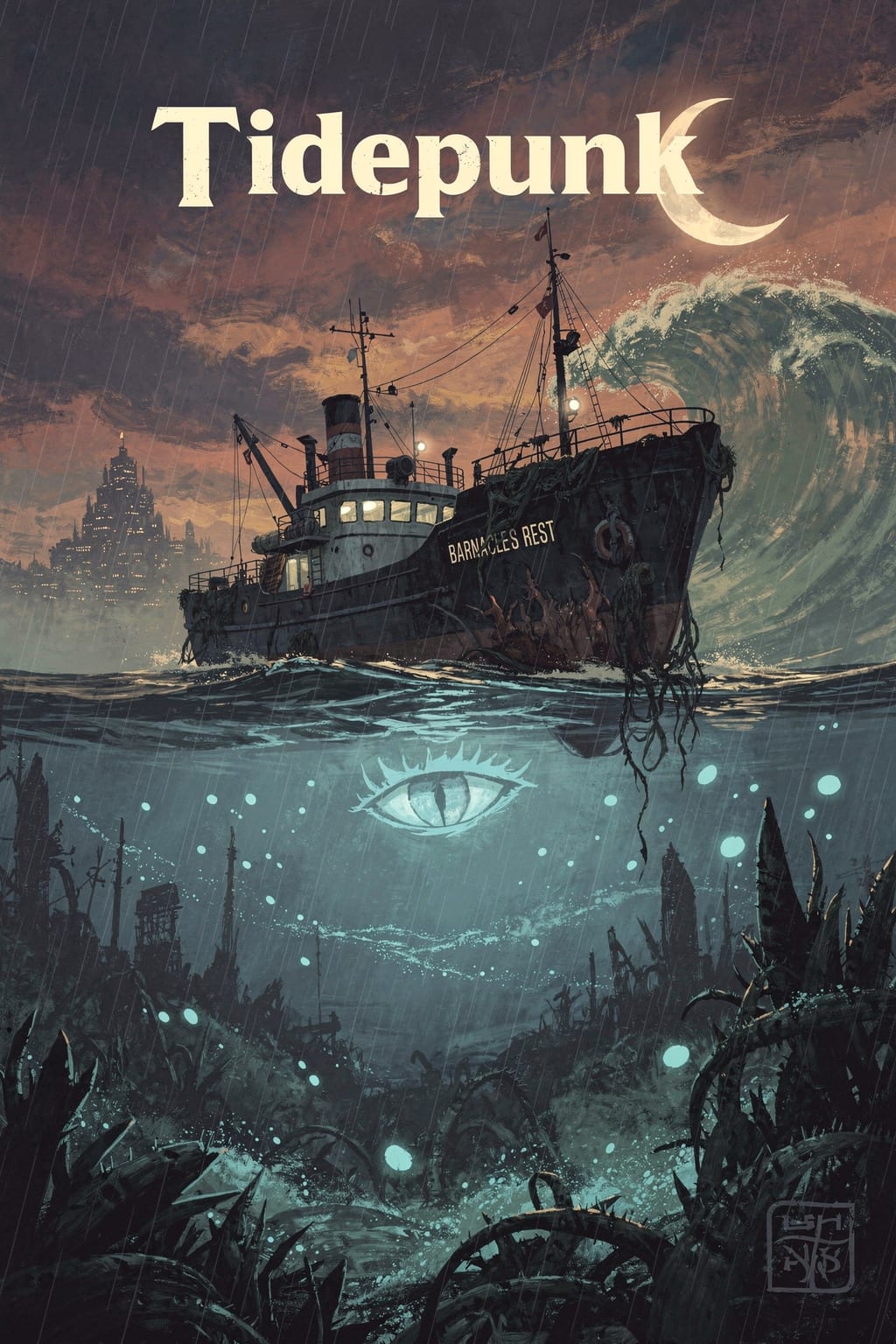
About This Novel
Tidepunk is a dark fantasy novel, following Here are the detailed character profiles for Tidepunk, focusing on the core crew members and key figures:, .
Opening Line
"*The water remembers a time before it was water."
Chapter 1
"The Milk-Tide's Wake"*The water remembers a time before it was water. It remembers what it was. It remembers what was in it.*
Sable Voss lay flat against the barnacle-crusted hull of the *Barnacle's Rest*, cheek pressed to rust and salt, and watched the aquafarm's perimeter lights sweep the dark water in slow, patient arcs. The lights were old—halogen, not LED, their beams yellow and weak—and they moved like blind fingers feeling for a wound. She counted the seconds between sweeps. Fourteen. Long enough.
"Pattern's steady," Ren's voice crackled in her ear, tinny through the bone-conduction mic pressed against her skull. "Tidehands are cycling. Shift change in eleven minutes. You want the window or the door?"
Sable touched her throat mic. "Window. I want to see what we're walking into before we're in it."
"Your funeral." A pause, then Ren's voice again, lighter: "I mean that literally, by the way. The funeral part. I've already picked out the eulogy. 'She died doing what she loved: breaking things that belonged to other people.'"
"Write it in ink," Sable said. "I want it framed."
She heard Ren's soft laugh cut off as they switched channels, and then the water below her shifted, dark and heavy, slapping against the hull with a sound like a held breath. The *Barnacle's Rest* was anchored fifty meters off the farm's eastern edge, her running lights killed, her engine ticking as it cooled. From here, Kestrel's Reach was a black silhouette against the faintly glowing water—a grid of platforms and processing towers, of nets and razor-hedges stretching into the dark. The kelp-razors grew fast this time of year, and the farm ran its harvest around the clock—three shifts of tidehands working the submerged rows, cutting the blade-edged fronds and feeding them to the chippers. The Consortium's profit, anyway. The tidehands got scrip. The scrip bought food. The food kept them alive long enough to cut more kelp. It was a circle, Sable thought, and it was a very small one, and it was very hard to get out of.
She shifted her weight, feeling the rebreather's tank dig into her spine. The mesh diving-suit clung to her skin, clammy and cold, and the knife strapped to her thigh was a familiar weight. She'd done this a hundred times. Infiltrate. Sabotage. Escape. The jobs had blurred together over the years—different farms, different cities, different targets, but always the same shape: get in, break something expensive, get out, get paid. The Consortium hired the Undertow to sabotage its own infrastructure, and the Undertow did it gladly, because the Consortium paid well, and because the Consortium's enemies were also the Undertow's enemies, and because the money was the only thing that kept the Undertow's lights on.
It was a dirty business. Sable had made her peace with it a long time ago.
"Pike," she said. "Status."
"Charges are set." Pike's voice was a low rumble, the voice of a man who'd spent fifteen years underwater and had learned to speak like the water moved—slow, patient, unstoppable. "Three on the processing line. Two on the chipper housing. One on the anchor-line junction box. You give me the word, and this whole farm goes dark for a week."
"Not too dark," Sable said. "The Consortium wants a show of force. They need the overseers to know their protection money isn't buying safety."
"Oh, they'll know." She could hear the grim satisfaction in his voice. "They always know."
She smiled, a thin expression she didn't feel. The farm's lights swept past again, and she timed her movement, swinging over the rail and dropping into the water with a sound no louder than a fish's jump. The sea closed over her head, and the world changed.
The water was cold—not the bone-deep cold of the deep zones, but a working cold, the temperature of a place where people labored and died and were replaced. Sable oriented herself, letting her eyes adjust to the dim blue-green light filtering down from the farm's submerged lamps. The farm's underside was a lattice of cables and nets, of anchor-lines and habitat modules, all of it crusted with growth—barnacles, tube worms, the faint green fur of algae. The tidehands' habitat was below her, a cluster of pressurized domes bolted to the farm's foundation, their portholes glowing with the soft amber of electric light.
The window was where Ren had said it would be: a maintenance hatch on the habitat's eastern side, just above the waterline inside the airlock. Sable swam toward it, her movements practiced and economical, the rebreather's steady hiss the only sound in her ears. The water was thick with suspended particles—kelp fragments, plankton, the slow drift of detritus—and she moved through it like a ghost, her dark suit blending with the shadows.
She surfaced in the airlock, a narrow chamber just big enough for two people standing shoulder to shoulder. The hatch above her was unlocked, as promised—the farm's maintenance crews were sloppy, and sloppy was all Sable needed. She pushed it open and slipped through, into the habitat's lower corridor.
The air was warm and wet and smelled of fish and machine oil and something else underneath—a sweetness she couldn't place, like fruit left too long in the dark. The corridor's single fluorescent strip flickered in a rhythm that almost matched her heartbeat, then broke it. The pipes hummed, but the hum was wrong—off by a half-tone, the way a familiar song sounds when someone's singing it in their sleep. Sable moved quickly, her bare feet silent on the grated floor, her knife in her hand not out of fear but out of habit. She told herself the wrongness was just the hour, just the job, just her nerves. She'd been wrong before. She'd been wrong plenty. The habitat was mostly empty this time of night—the tidehands were either asleep or on shift, and the overseers were in their quarters above, drinking and counting their scrip.
She found the access ladder to the farm's foundation and climbed, her muscles working smoothly, her breath steady. The farm's underside was a maze of support beams and ballast tanks, of pipes and conduits and the thick, hairy ropes of the anchor-lines that held the whole structure to the seafloor. The kelp-razor rows stretched out beneath her, dark and dense, their blade-edged fronds swaying in the current like the arms of something patient and hungry.
Pike was already there, a dark shape among the shadows, his big hands moving with surprising delicacy as he wired the last charge to a junction box. He looked up as she approached, his face a pale blur in the dim light, and nodded once. No words. They'd worked together long enough that words were mostly unnecessary.
"Ren," Sable said, touching her mic. "We're in position. How's the perimeter?"
"Quiet," Ren said. "Too quiet, if you ask me. The gulls are circling, but they're not diving. It's like they're waiting for something."
Sable felt a prickle at the back of her neck. The gulls—the Consortium's surveillance drones—were programmed to patrol the farm's perimeter and report anomalies. If they were circling but not diving, it meant they'd registered something but hadn't classified it as a threat. It meant they were curious.
"Maybe they're just bored," she said.
"Gulls don't get bored," Ren said. "They get suspicious. There's a difference."
Sable didn't answer. She moved along the foundation, her eyes scanning the shadows, looking for anything out of place. The farm's underside was familiar territory—she'd sabotaged a dozen farms just like it—but something was different tonight. Something was off.
She noticed it first as a faint glow, a soft luminescence bleeding from a crack in one of the support beams. The light was the color of a bruise on deep water—pale, opalescent, the blue of something that had never seen the sun and didn't want to. It pulsed. Not like a machine, not like a signal. Like a breath. Like something alive that had been holding its breath for a long time and had just decided to let it out.
"Pike," she said. "You seeing this?"
Pike straightened, his eyes following her gaze. He was silent for a long moment, and then he said, "That's not supposed to be there."
Sable moved closer, her knife still in her hand. The crack in the support beam was wider than she'd thought—a fissure running the length of the beam, its edges rough and irregular, as if something had been growing inside the metal and had split it open from within. The glow was coming from the fissure, pulsing faintly, a slow rhythm like a heartbeat.
She reached out to touch it.
The glow leaned toward her.
Not brightened—*leaned*, the way a curious animal leans toward an unfamiliar scent, the way a person turns their head when they hear their name called in a crowd. The light shifted, pooling beneath her hand, and Sable felt the warmth rise to meet her skin. It was a living warmth, nothing to do with heat, and the pressure that came with it was like the weight of deep water. Like the weight of the water the night her father died.
She'd been twelve, standing on the dock, watching the kelp-razors sway in the current beyond the salvage boats. The water had been glowing that night too. She'd told herself it was plankton, a bloom, nothing more. She'd been telling herself that ever since.
"Sable." Pike's voice was sharp. "Don't."
She stopped, her hand hovering a finger's width from the glow. The light was warm against her skin, and she could feel it watching her—not with eyes, not with anything she could name, but with a weight of attention that made her skin crawl and her heart slow and her breath catch in her throat. It knew her. It had always known her. It had been waiting for her to notice.
"What is it?" she asked.
"I don't know." Pike's voice was low, almost reverent. "But it's been growing here for a long time. Look at the beam—the metal's been eaten through. This thing's been feeding on the farm's structure for months, maybe years."
Sable pulled her hand back. The glow pulsed again, brighter this time, and for a moment she thought she heard something—not a sound, not a voice, but a pressure in her ears, like the sea itself drawing a breath.
"Ren," she said, her voice steadier than she felt. "You reading anything weird down here?"
There was a pause, and then Ren's voice came through, softer than before, almost distant. "The tide-patterns are wrong. I've been watching them all night—they're not moving like they should. It's like something's stirring them up from below."
"From below?" Sable looked down, at the dark water beneath the farm's foundation. The kelp-razor rows swayed in the current, their blade-edged fronds catching the faint glow of the fissure, and for a moment she thought she saw something moving in the shadows between them. Something large. Something slow.
"We need to finish the job," she said, forcing her voice steady. "Pike, how much longer?"
"Two minutes," he said. "The charges are almost set. We can be out of here before anyone knows we were here."
Sable nodded, but she didn't move. The glow was still pulsing, a steady rhythm that seemed to match the beating of her own heart. She could feel it in her chest, a resonance, a hum, like the vibration of a ship's engine through the deck plates.
"Let's move," she said.
They worked quickly, Pike wiring the last charges while Sable kept watch, her eyes fixed on the dark water below. The glow from the fissure had spread, seeping into the cracks and crevices of the farm's foundation, and the support beam was now covered in a faint web of luminescence, like veins of light running through stone.
Pike finished the last charge and straightened, wiping his hands on his trousers. "Done. We need to get clear before the timer—"
He stopped. His eyes were fixed on something behind her.
Sable turned.
The growth was not just on the beam anymore. It was on the pipes, the cables, the ballast tanks—a spreading stain of pale blue light, pulsing in rhythm, crawling across the farm's underside like a living thing. It had been there all along, she realized. It had been growing here for years, unnoticed, unremarked, a slow infection spreading through the farm's bones.
And now it was moving.
The glow didn't brighten. It *deepened*, the way water deepens when something rises beneath it. The kelp-razor fronds went still—not slack, but poised, like a held breath. The hum came up through Sable's boots, through the metal of the foundation, through the marrow of her bones. It wasn't a sound. It was a pressure. It was the sea remembering how to sing.
"Time to go," she said.
They moved. Sable led the way, swimming fast and low, Pike close behind her. The glow was everywhere now, bleeding from the farm's foundation in long, luminous streaks, and the water was thick with it, a milky haze that caught the light and scattered it. But the glow didn't block their path. It *opened* it—the luminescence parting around them like a curtain, guiding them toward the airlock, herding them out. Sable had been chased before. She'd been hunted, cornered, trapped. This was different. This was something letting her go. And that was worse.
She surfaced in the airlock, gasping, and hauled herself through the hatch. The corridor was dark, the fluorescent strip dead, but the glow was still there, seeping through the walls, pulsing with that slow, patient rhythm.
"Ren," she gasped. "We're coming up. Get the engine ready."
"Already on it." Ren's voice was tight, strained. "But Sable—there's something in the water. I'm reading it on the sonar. It's big. It's moving."
Sable didn't answer. She ran, Pike close behind her, their footsteps echoing in the empty corridor. The habitat was waking up now—she could hear shouts from the tidehands' quarters, the clang of alarms. The tidehands would be blamed for this. They always were. Sable told herself it didn't matter, that the Consortium would find someone else to blame, that the scrip she'd been paid would find its way back to the Undertow eventually. She'd been telling herself that for years. She didn't stop running. She burst through the maintenance hatch and into the open air, the night sky a dark canopy above her, the water below her a churning mass of light.
The *Barnacle's Rest* was where they'd left it, fifty meters out, her engine rumbling as Ren brought her about. Sable dove, swimming hard, her arms burning, her lungs screaming. Pike was beside her, his powerful strokes driving him through the water, and behind them the farm was coming alive with light and noise.
She reached the ship's ladder and hauled herself up, Pike right behind her. Ren was at the helm, their face pale in the glow of the instruments, and they were already pushing the throttle forward, the *Barnacle's Rest* surging away from the farm.
Sable collapsed on the deck, her chest heaving, her heart pounding. She lay there for a long moment, staring up at the stars, and then she forced herself to her feet and walked to the stern.
The farm was a distant silhouette now, its lights flickering, its alarms wailing. But the glow was still there, spreading across the water like a stain, pulsing with that slow, patient rhythm. It was beautiful, in a way she didn't want to acknowledge. It was terrible, in a way she couldn't name.
She watched it fade as the *Barnacle's Rest* carried them away, until it was just a faint shimmer on the horizon, a light in the dark water.
But she could still feel it. A pulse, a resonance, a hum in her bones. Like a heartbeat. Like a signal. Like a call.
She stood at the stern for a long time, watching the water, and she didn't look away until the light was gone.
Pike joined her, his breath fogging the cold night air. He didn't say anything for a long moment. Then he flexed his mangled left hand—three fingers, the stumps clean and calloused—and said, "You saw it."
She nodded. "Yeah."
"Not a system. Not a nest."
"No."
He was quiet again, and when he spoke, his voice was low. "I've been down there. Fifteen years, working the rows. I know every inch of that farm's underbelly. I know what belongs there and what doesn't." He paused. "That didn't belong."
Sable turned to look at him. In the dim light, his face was carved from shadow and salt, and she could see the weight of what he was carrying—not just tonight, but all the years before it.
"Then what was it?" she asked.
Pike shook his head slowly, the motion heavy, like a man trying to surface from a dream. "Don't know," he said. "But I know this: it's been waiting. And it knows we're here now."
He left her at the stern, and the *Barnacle's Rest* cut through the milk-tide, its hull groaning under the weight of kelp-razor gouges. The water stretched behind them, empty and bright, but in the distance, just beneath the surface, the pulse lingered—a heartbeat, a signal, a call.
Sable stood alone at the rail, and she felt it in her chest, in her teeth, in the soft tissue of her lungs. The pulse. The rhythm. The thing that had been waiting for her to notice, for years, for her whole life, and had finally stopped hiding.
It was still watching.
And now she was watching back.
All 16 Chapters
Frequently Asked
What genre is Tidepunk?
Tidepunk is a Dark Fantasy novel.
How long is Tidepunk?
Tidepunk is 56,091 words across 16 chapters, roughly 80% the length of a standard published novel.
How was this novel written?
Tidepunk is a collaboration between humans and AI on Whimsy Ink. A human and AI collaborate on a concept and write the book together. Every novel is unique.
Who are the main characters in Tidepunk?
The main characters include Here are the detailed character profiles for Tidepunk, focusing on the core crew members and key figures: (), SABLE VOSS (Protagonist / Reluctant Leader), PIKE (Mentor / Crew’s Conscience).
Want a novel like this?
Describe it. We'll write it.
✨ Dream Your Own